The decision between open-source and proprietary large language models is no longer a straightforward question of quality. Models like Llama 3, Mistral, and Qwen have closed the performance gap on standard benchmarks to the point where the choice hinges less on raw capability and more on a set of interrelated factors: inference cost at your specific volume, data privacy constraints, the degree of customization your application demands, and the operational complexity your team is equipped to absorb. Framing this as "free vs paid" or "good vs good enough" misses the actual decision problem.
Most teams get this wrong not because they lack information, but because they default to one side without running the numbers for their particular situation. The economics of open-source vs proprietary LLMs are highly volume-dependent, and the crossover points are specific enough that a team spending $1,500 per month on API calls and a team spending $15,000 per month should arrive at fundamentally different architectures. This analysis works through the comparison systematically, with data where it matters, so you can make that determination for your own workload.
How the performance gap has shifted
Two years ago, open-source models sat a clear tier below proprietary offerings on virtually every task. That gap has closed faster than most industry observers anticipated, and understanding where it persists and where it has disappeared is essential for making a well-informed model selection decision.
The proprietary tier
The major proprietary model families, OpenAI's GPT-4o line, Anthropic's Claude 3.5 series, and Google's Gemini 1.5, continue to represent the easiest on-ramp for AI integration. You obtain an API key, send requests, and pay per token. There is no infrastructure to manage, no model weights to download, and no GPU procurement to navigate. That operational simplicity is a genuine advantage, and it should not be dismissed as a convenience for teams that lack ambition.
The open-source tier
Meta's Llama 3 family (8B, 70B, 405B), Mistral's range from the 7B base model through Mixtral 8x7B to Mistral Large, Alibaba's Qwen 2.5 series, and DeepSeek's V3 and R1 models collectively represent a deep bench of open-weight alternatives. These models are available under permissive licenses (with caveats worth examining, discussed below) and can be run on your own hardware, fine-tuned on proprietary data, and modified at the architecture level.
What makes this moment distinct is that the open-source tier is no longer a budget substitute. On standardized benchmarks, the top open-source models are within striking distance of, and in some cases match, the best proprietary offerings.
Performance comparison: what the benchmarks show
| Benchmark | GPT-4o | Claude 3.5 Sonnet | Llama 3 70B | Llama 3 405B |
|---|---|---|---|---|
| MMLU | 88.7% | 88.7% | 82.0% | 88.6% |
| HumanEval | 90.2% | 92.0% | 81.7% | 89.0% |
| GSM8K | 95.8% | 96.4% | 93.0% | 96.8% |
Llama 3 405B essentially ties GPT-4o on MMLU and surpasses it on GSM8K. Even at the 70B scale, the delta on math reasoning (GSM8K) is less than three percentage points. These results would have been unthinkable in 2023.
However, benchmarks capture only a slice of what matters in production. Proprietary models continue to demonstrate stronger performance on tasks that resist standardized measurement: following complex multi-step instructions, maintaining coherence over long-form outputs, handling ambiguous prompts with appropriate judgment, and recovering from mid-conversation corrections. These qualitative differences are difficult to quantify but consistently observable when deploying models at scale.
That distinction matters for this analysis because it means the right model selection framework is not "which scores higher on MMLU" but rather "which performs better on the specific distribution of tasks my application will encounter." For a deeper exploration of how to evaluate models against your particular requirements, our guide to choosing the right AI model walks through that process in detail.
Where open-source models hold a genuine quality advantage
The most compelling quality argument for open source is not that these models match proprietary ones on general benchmarks, but that they can surpass them on domain-specific tasks through fine-tuning. A Llama 3 70B fine-tuned on 50,000 examples of your company's support tickets will outperform GPT-4o on that specific task, because the base model quality becomes secondary to the quality and relevance of your training data once fine-tuning enters the picture.
Smaller open-source models in the 7B to 8B parameter range also demonstrate strong performance on focused tasks like classification, entity extraction, and structured output generation. Deciding whether an email is a complaint or a feature request does not require 400 billion parameters, and deploying a model ten times larger than necessary for a classification task is a straightforward waste of compute budget.
Where proprietary models retain an edge
Complex reasoning chains, creative writing with stylistic nuance, sophisticated code generation, and multimodal tasks (vision, audio, tool use) remain areas where proprietary models hold a measurable advantage. If your application requires the model to synthesize information across a 100K-token context window and produce a coherent analytical output, you will get better results from a frontier proprietary model than from an equivalently sized open-source alternative.
The gap is narrowing each quarter, but it has not disappeared. Pretending otherwise leads to poor architecture decisions.
The cost equation, and why scale changes everything
This is where the open-source vs proprietary comparison becomes most consequential, because the answer depends almost entirely on your volume.
| Approach | Cost per 1M input tokens | Cost per 1M output tokens | Monthly fixed cost |
|---|---|---|---|
| GPT-4o API | $2.50 | $10.00 | $0 |
| Claude 3.5 Sonnet API | $3.00 | $15.00 | $0 |
| Llama 3 70B (hosted API) | $0.59 | $0.79 | $0 |
| Llama 3 70B (self-hosted) | ~$0.15 | ~$0.15 | $4,000+ GPU rental |
The structure of these costs creates a clear crossover dynamic. At low volume, proprietary APIs win on total cost because they carry no fixed infrastructure burden. If you are spending $500 per month on OpenAI, self-hosting the equivalent workload would cost $4,000 or more in GPU rental alone, before accounting for the engineering time required to keep the deployment operational.
The crossover point falls at roughly $5,000 per month in API spend. Above that threshold, self-hosting begins to yield savings. At $20,000 per month in API costs, self-hosting the same workload on Llama 3 70B typically runs $6,000 to $8,000, including infrastructure and operational overhead. The savings scale superlinearly because GPU utilization improves as request volume increases, amortizing the fixed cost across more inferences. Our self-hosting cost breakdown of DeepSeek-V3 works through one of these crossover calculations against a real model.
There is also a middle ground worth considering. Hosted open-source API services (Together, Fireworks, Replicate, and similar providers) run open-source models on shared infrastructure and pass the cost savings through to you. You lose the data privacy benefits of true self-hosting, but you retain the per-token cost advantage without the infrastructure burden. For teams in the $2,000 to $5,000 monthly range, this is often the most practical option.
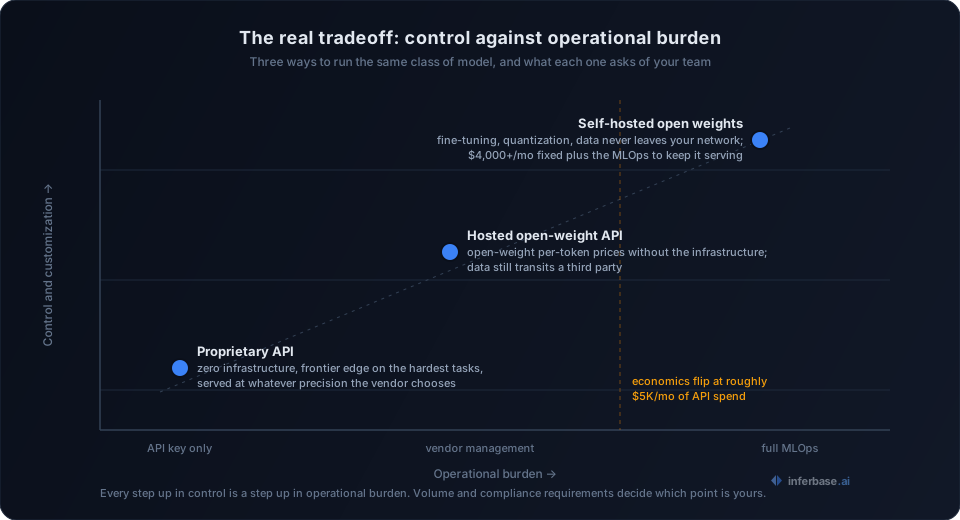
For a detailed breakdown of where inference spending actually goes and how to optimize it, our LLM cost optimization guide covers the components in depth.
Privacy and data control: a constraint, not a preference
For a significant number of organizations, data privacy is not a factor to weigh against cost and convenience. It is a hard constraint that narrows the decision space immediately.
Proprietary APIs require that your data leave your infrastructure. Every prompt and every response traverses a third party's servers. Most providers offer data processing agreements, and some explicitly commit to not training on customer data. But there is a meaningful difference between "trust our policy" and "the data never left our network." For organizations operating under regulatory frameworks, the distinction is not philosophical.
Self-hosted open-source deployment keeps everything on your hardware. You control the logs, the retention policy, the access controls, and the audit trail. For healthcare organizations subject to HIPAA, financial services firms navigating SOC 2 and regulatory reporting requirements, government agencies, and any organization handling PII at scale, self-hosting is frequently the only path that satisfies compliance.
It is worth noting that the hosted open-source API approach does not resolve this concern. Your data still travels to a third party, and the fact that the model weights are open source does not change the data residency characteristics of the deployment. If privacy is the driver behind your interest in open-source models, self-hosting is the only architecture that delivers on that requirement.
Customization and control: the structural advantage of open source
The customization argument for open source extends well beyond the ability to fine-tune, though that alone is significant.
Fine-tuning on proprietary data is the single most important capability that open-source models provide and proprietary APIs constrain. Training a Llama 3 70B on your legal documents, medical records, or internal codebase yields a model that outperforms general-purpose proprietary alternatives on tasks specific to that domain. Proprietary fine-tuning APIs exist (OpenAI, Google, and others offer them) but they impose restrictions on what you can adjust, cost more per training iteration, and give you less visibility into the resulting model's behavior.
Quantization and precision trade-offs are decisions you can make when you control the model weights. Running a 70B model in 4-bit quantization cuts VRAM requirements roughly in half with a modest quality degradation, a trade-off that is often worthwhile for latency-sensitive applications. With proprietary APIs, you receive whatever precision the provider has chosen to serve. If you are planning to self-host and want to understand the GPU memory implications of different quantization strategies, our GPU sizing guide covers the calculations.
Architecture-level modifications, including LoRA adapters, attention mechanism modifications, speculative decoding, and custom serving pipelines built on vLLM, TGI, or SGLang, are available only when you have access to the model weights. None of this is possible through an API endpoint.
Throughput that scales with your hardware rather than with a provider's rate limit tier is the final structural advantage. If you need to process a million documents overnight, you provision more GPUs. You do not file a support ticket requesting a higher rate limit and wait for approval.
Licensing: the detail that determines whether "open" means what you think
The term "open source" in the LLM ecosystem does not carry a single, consistent meaning, and the licensing distinctions have practical consequences that surface at exactly the wrong moment if you have not reviewed them in advance.
Llama 3's license includes a clause requiring companies with over 700 million monthly active users to negotiate a separate commercial agreement with Meta. For the vast majority of organizations this is irrelevant, but for large consumer platforms it introduces a dependency that warrants legal review.
Mistral's models use the Apache 2.0 license, which is genuinely permissive with no usage restrictions, making it the cleanest option from a licensing perspective. Qwen and DeepSeek models carry their own license terms that vary by model size and version and require individual assessment.
The distinction between "open weights" (you can download and run the model) and "open source" in the traditional software sense (you can modify and redistribute without restriction) is not academic. It matters when your legal team asks, and they will ask before any production deployment.
When proprietary models are the right choice
Proprietary APIs should be the default in specific, identifiable situations, and recognizing when you are in one of them prevents wasted effort on premature infrastructure investment.
- Prototyping and validation. Zero setup time, instant access, and rapid iteration make APIs the right choice when you have not yet validated the use case. Spending three weeks configuring inference infrastructure before confirming that the product concept works is an inversion of priorities.
- Small teams without MLOps capacity. Running self-hosted models reliably requires operational expertise in GPU management, model serving, monitoring, and failover. If your team is three engineers building a product, that operational burden is not justified.
- Frontier-quality requirements. For the hardest reasoning tasks, the latest proprietary models still hold an edge. If your application's viability depends on that last 5% of quality, pay for it. Our analysis of self-hosting a Claude-class agent quantifies how far open weights get you on that tier.
- Low volume. Under $2,000 per month in API costs, self-hosting is more expensive by a wide margin, regardless of which open-source model you choose.
- Multimodal capabilities. Vision, audio processing, and tool use are more mature in proprietary offerings. Open-source multimodal models are improving but have not reached parity.
When open source is the stronger option
Open source becomes the clearly better architecture when certain conditions align, and when they do, the advantage is not marginal but structural.
- Data privacy as a compliance requirement. Healthcare, financial services, government, or any domain with strict data residency rules. Self-hosting is the only deployment model that guarantees your data never leaves your infrastructure.
- High-volume inference. Millions of requests per day, or batch processing workloads that would cost a fortune through per-token APIs. The economics shift decisively, and the savings compound as volume grows.
- Domain-specific customization needs. Fine-tuning on your proprietary data for tasks where generic models underperform is the single most powerful advantage open source provides, and it is not replicable through proprietary APIs with anywhere near the same flexibility.
- Vendor independence as a strategic priority. API providers can change pricing, deprecate model versions, modify terms of service, or experience outages at times you cannot predict. Self-hosted models eliminate this entire category of risk.
- Latency-critical applications. Self-hosted models on local infrastructure eliminate network round-trips entirely. For real-time applications where time-to-first-token budgets are measured in tens of milliseconds, this is a meaningful architectural advantage.
The hybrid approach: the architecture most teams should converge on
The position this analysis takes is direct: most production AI systems should use both open-source and proprietary models, routed by task complexity. A single-model architecture is almost always either overspending on simple tasks or underperforming on hard ones. The model router pattern resolves this tension.
                    ┌──────────────────┐
                    │   Model Router   │
                    └────────┬─────────┘
                             │
              ┌──────────────┼──────────────┐
              ▼              ▼              ▼
        ┌──────────┐  ┌──────────┐  ┌──────────┐
        │ Frontier  │  │ Mid-tier │  │ Small    │
        │ model     │  │ model    │  │ model    │
        │ (hard)    │  │ (medium) │  │ (simple) │
        └──────────┘  └──────────┘  └──────────┘
         Proprietary   Hosted API    Self-hosted
The routing logic does not need to be sophisticated to capture most of the value. Task type alone provides a reasonable first-pass heuristic:
- Simple classification, extraction, and routing tasks can be handled by a self-hosted small model (Llama 3 8B, Mistral 7B). These tasks do not benefit from a frontier model, and a self-hosted solution handles them at a fraction of the per-token cost.
- Standard generation, summarization, and question-answering fits well with a mid-tier hosted API (GPT-4o-mini, Claude 3.5 Haiku, or hosted Llama 3 70B). The quality is more than sufficient, the per-token pricing is reasonable, and there is no infrastructure to manage.
- Complex reasoning, creative generation, and edge cases justify a frontier proprietary model (GPT-4o, Claude 3.5 Sonnet, o1). The key insight is that these requests typically represent only 10-20% of total volume in most production systems.
This tiered approach reduces total inference costs by 40-60% compared to routing everything through a single frontier model, with minimal quality degradation on the tasks that get routed to smaller or less expensive models. The savings are not hypothetical; they are a direct consequence of the fact that most production request distributions are dominated by simpler tasks that do not require frontier-level capability.
A decision framework
Five questions structure this decision effectively:
- What is your monthly inference budget? Under $2,000, proprietary APIs are cheaper after accounting for infrastructure costs. Over $5,000, the self-hosting economics deserve serious analysis.
- Can your data leave your infrastructure? If the answer is no, self-hosted open source is the only viable option. There is no workaround that preserves both compliance and the convenience of third-party APIs.
- Does your team have MLOps expertise? If not, start with APIs and build operational capability incrementally. Self-hosting without the maturity to manage GPU infrastructure, model updates, and serving reliability leads to downtime that costs more than API margins.
- How specialized is your domain? If general-purpose models handle your tasks adequately, APIs offer the simpler path. If you need fine-tuning to reach quality targets, open source is the only architecture that provides the necessary control.
- What is your latency budget? Under 100ms for time-to-first-token means self-hosted or edge deployment. API round-trips add 50-200ms of network latency depending on geography, and that overhead is unavoidable regardless of the provider.
Where to go from here
Benchmark tables provide a starting point for model comparison, not a conclusion. The only evaluation that determines the right model for your system is how each candidate performs on your actual data, with your actual prompt patterns, at your actual volume.
- Compare models side-by-side on the metrics relevant to your use case
- Estimate your GPU requirements to determine whether self-hosting makes financial sense at your scale
- Browse open-source models in our catalog to identify candidates worth testing
The most durable architectural decision you can make is to design for model-agnosticism from the start. The weights question (open or proprietary) is separable from the access question (someone's API or your own GPUs): the three inference access patterns exist precisely because teams move between them as volume grows, and a clean abstraction layer between your application logic and the model provider is what makes that move a configuration change instead of a rewrite. When a better open-source model releases, or when a proprietary provider adjusts pricing, the teams that built this flexibility in early are the ones that consistently capture the best cost-quality ratio as the ecosystem evolves.