Choosing the best LLM for coding depends on what kind of coding you are doing. A model that excels at generating standalone functions may struggle with multi-file refactoring. One that writes clean Python may produce mediocre TypeScript. The model that tops a benchmark leaderboard may be too slow or too expensive for the way your team actually writes code.
The field has split into distinct tiers. Anthropic's Claude family has taken a clear lead on coding benchmarks, with Sonnet 4.6 scoring a coding index of 50.9 on Artificial Analysis. OpenAI's dedicated GPT-5.1-CODEX-mini offers the best cost-to-quality ratio for high-throughput coding workflows. And DeepSeek's V3.1-Terminus delivers competitive code generation at a fraction of frontier pricing.
This is also a field where the ranking moves. The analysis below reflects the evidence at the time of writing; our best models for coding page carries the current quality-ranked standings and updates as benchmark evidence and pricing change.
What matters is matching the model to the specific coding workflow: autocomplete, test generation, debugging, code review, or full-feature implementation from a spec. That framing is the whole argument of this guide: the cost of getting it wrong is not just picking a slightly worse model, it is paying frontier prices for autocomplete or feeding an agent loop with a model that cannot hold the plan.
What makes a good coding LLM
Before comparing specific models, it helps to define what "good at coding" actually means in practice. There are four distinct capabilities that matter, and no single model leads across all of them.
Code generation is the most obvious: given a natural language prompt, produce working code. This is what LiveCodeBench and the Artificial Analysis coding index measure. Performance correlates with model size and training data quality, but the gap between top models has narrowed in some tiers while widening at the frontier.
Code understanding is the ability to reason about existing code: explaining what a function does, identifying bugs, suggesting improvements. Models with larger context windows have an advantage here because they can process more of the surrounding codebase without fragmented prompting.
Instruction following determines how reliably the model does what you ask. A model might be capable of writing a binary search, but if it ignores your constraint to "use iterative, not recursive" or adds unnecessary error handling you did not request, its practical value drops. This is harder to benchmark but matters enormously in production.
Tool use and structured output matters for IDE integrations, coding agents, and automated pipelines. Function calling, JSON mode and structured outputs, and reliable stop sequences are table stakes for any model embedded in a development workflow.
The models compared
We evaluated nine models that are actively available through major API providers and demonstrate strong coding capabilities. The selection covers frontier models, cost-efficient mid-tier options, and open-source alternatives.
| Model | Provider | Context | Input/Output per 1M | Coding Index | LiveCodeBench | Intelligence Index |
|---|---|---|---|---|---|---|
| Claude Sonnet 4.6 | Anthropic | 1M | $3.00 / $15.00 | 50.9 | N/A | 51.7 |
| Claude Opus 4.6 | Anthropic | 1M | $5.00 / $25.00 | 48.1 | N/A | 53.0 |
| GPT-5.1-CODEX-mini | OpenAI | 400K | $0.25 / $2.00 | 35.0 | 83.6% | 38.0 |
| DeepSeek V3.1-Terminus | DeepSeek | 164K | $0.21 / $0.79 | 32.5 | 79.8% | 33.5 |
| DeepSeek V3.2-exp | DeepSeek | 164K | $0.21 / $0.32 | 28.9 | 55.4% | 28.0 |
| GPT-4.1 | OpenAI | 1M+ | $2.00 / $8.00 | 21.2 | 45.7% | 25.8 |
| o3-mini | OpenAI | 200K | $1.10 / $4.40 | 17.0 | 73.4% | 27.7 |
| Llama 4 Maverick | Meta | 1M+ | $0.15 / $0.60 | 15.3 | 39.7% | 18.9 |
| Devstral | Mistral | 262K | $0.05 / $0.22 | N/A | N/A | N/A |
Coding Index and Intelligence Index sourced from Artificial Analysis. LiveCodeBench scores from LiveCodeBench. Pricing reflects API rates as of April 2026. For the standings as they are today, see the continuously updated coding rankings.
Best overall: Claude Sonnet 4.6
Claude Sonnet 4.6 leads the field with a coding index of 50.9, well ahead of every other model on this list. Combined with a 1M token context window, code generation capability, function calling, JSON mode, and strong reasoning, it is the most complete coding model available.
The 1M context window means full-repository analysis, multi-file refactoring, and large PR reviews are all within scope without fragmented prompting. At $3.00/$15.00 per million tokens, it is expensive relative to the mid-tier models but significantly cheaper than Opus while delivering higher coding performance.
At 69 output tokens per second, throughput is adequate for interactive use though not the fastest on this list.
Best for: Teams that want the highest coding quality with a large context window. Complex refactoring, architecture-level code review, and tasks that benefit from deep understanding of large codebases.
Best for deep reasoning: Claude Opus 4.6
Claude Opus 4.6 has the highest intelligence index (53.0) of any model compared here and a coding index of 48.1, slightly behind Sonnet. The distinction matters: Opus excels on problems that require extended reasoning, working through ambiguous requirements, and tasks where the model needs to hold complex state in its reasoning chain.
At $5.00/$25.00 per million tokens, it is a premium option. The same 1M context window as Sonnet keeps it viable for large codebase work. Extended thinking capabilities make it particularly strong for debugging complex systems, designing architectures, and evaluating multiple solution paths.
Best for: Architecture design, complex debugging, system design decisions, and coding tasks that require deep reasoning. Not cost-effective for routine code generation where Sonnet matches or exceeds its coding performance at a lower price.
Best dedicated coding model: GPT-5.1-CODEX-mini
OpenAI's dedicated coding model has a coding index of 35.0 and the highest LiveCodeBench score on this list at 83.6%. Where it stands out is the combination of code-specific capabilities: code completion, code generation, code review, function calling, and JSON mode, all purpose-built for developer workflows.
At $0.25/$2.00 per million tokens, it is dramatically cheaper than the Claude models. The 400K context window is generous for most single-repository tasks. With 159 output tokens per second, it is also the fastest model here, making it well-suited for autocomplete and interactive coding.
The gap between its coding index (35.0) and Claude Sonnet's (50.9) is real. For straightforward function writing and structured coding tasks, that gap may not matter in practice. For complex multi-step problems requiring reasoning across a large codebase, it does.
Best for: Cost-effective coding at scale. IDE integrations, coding agents, CI/CD pipelines, and autocomplete where speed and cost matter as much as peak quality. Teams that want strong coding performance at a fraction of frontier pricing.
Best value: DeepSeek V3.1-Terminus
DeepSeek V3.1-Terminus has a coding index of 32.5 and LiveCodeBench score of 79.8% at $0.21/$0.79 per million tokens. That makes it the highest quality-per-dollar option for code generation by a significant margin.
The 164K context window is sufficient for most tasks, though it falls short for full-repository analysis. The trade-off relative to GPT-5.1-CODEX-mini is primarily in tool use reliability and the dedicated code capabilities (completion, review) that OpenAI's model bundles.
Best for: High-volume code generation where cost is a primary constraint. Batch processing of code tasks, automated test generation, and scenarios where you can tolerate occasional formatting issues in exchange for significant cost savings.
Best for large codebases on OpenAI: GPT-4.1
GPT-4.1's 1M+ token context window is its defining feature for coding workflows. At $2.00/$8.00 per million tokens, it is cheaper than both Claude models while offering a comparable context window.
Its coding index of 21.2 trails the dedicated coding models and Claude by a wide margin. The practical question is whether the coding quality gap justifies choosing it over Claude Sonnet 4.6 ($3.00/$15.00), which offers both a higher coding index and equivalent context. For teams already committed to OpenAI's platform, it remains a viable option for large-context work without switching providers.
Best for: OpenAI-committed teams that need 1M+ context for large codebase analysis and multi-file refactoring.
Best open source: Llama 4 Maverick
Meta's Llama 4 Maverick brings a 1M+ token context window and a 400B parameter MoE architecture to the open-source space. At $0.15/$0.60 per million tokens through API providers, it is the cheapest option for large-context coding tasks.
Its coding index of 15.3 and LiveCodeBench of 39.7% put it well behind the proprietary frontier. But for organizations that require self-hosting for compliance or data privacy reasons, Maverick is the strongest open-source option for coding with a large context window. The model can also be fine-tuned on internal codebases, something proprietary APIs do not allow.
Best for: Teams that need to self-host for data privacy or compliance. Cost-sensitive deployments at high volume where proprietary APIs are not an option.
Best for reasoning-heavy coding: o3-mini
OpenAI's o3-mini takes a different approach. Its coding index of 17.0 seems modest, but its LiveCodeBench score of 73.4% tells a different story. The gap between these numbers reflects o3-mini's strength: it performs disproportionately well on problems that require multi-step reasoning, algorithmic thinking, and debugging complex logic.
Chain-of-thought and extended thinking capabilities make it strong for debugging, algorithm design, and problems where the first attempt is unlikely to be correct. The trade-off is latency and cost ($1.10/$4.40), since reasoning tokens add both time and expense to every response.
For reasoning-heavy coding, Claude Opus 4.6 is the stronger option if budget allows. o3-mini occupies the niche of reasoning-capable coding at a more accessible price point.
Best for: Debugging complex issues, algorithm design, and competitive programming problems on a budget.
Best budget option: Devstral
Mistral's Devstral at $0.05/$0.22 per million tokens is the cheapest option by a wide margin. It is a 24B parameter model with a 262K context window, positioned for coding tasks where cost efficiency is the primary concern.
Independent benchmark data from Artificial Analysis is not yet available for Devstral, so a direct comparison on coding index is not possible. Mistral's own benchmarks claim competitive performance for its size class. The 262K context window is competitive with much larger models.
Best for: Budget-constrained development, hobbyist projects, prototyping, and high-volume tasks where a moderate-quality model at very low cost is preferable to a premium model at 20-40x the price.
One session, three request shapes
The rankings above treat "coding" as one workload. In practice it is the clearest example of heterogeneous traffic that exists: the same developer, in the same afternoon, generates requests whose context size, latency tolerance, and quality bar have almost nothing in common.
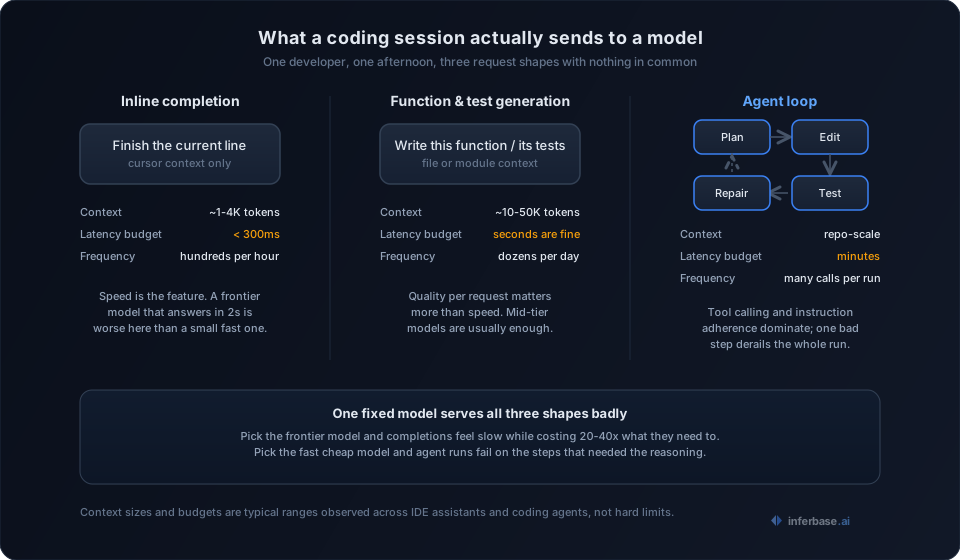
This is why a single fixed model choice serves coding traffic badly at one end or the other. Route completions to a frontier model and they feel slow while costing a large multiple of what they need to; route agent steps to the fast cheap model and runs fail exactly on the steps that needed the reasoning. Treating the model choice as a per-request decision rather than a per-team decision is the subject of model routing, and our guide to model routing for coding agents applies it to this workload specifically.
Choosing by coding task
Different coding workflows have different requirements. The table below maps common tasks to the most relevant model characteristics.
| Task | Key requirement | Recommended model | Rationale |
|---|---|---|---|
| Complex refactoring | Code quality + large context | Claude Sonnet 4.6 | Highest coding index (50.9) + 1M context |
| Architecture design | Deep reasoning | Claude Opus 4.6 | Highest intelligence index (53.0) |
| Autocomplete / inline | Low latency, high throughput | GPT-5.1-CODEX-mini | 159 tokens/sec, purpose-built for code |
| Full function generation | Code quality at reasonable cost | GPT-5.1-CODEX-mini | Best coding index under $3/1M output |
| Test generation | Cost at volume | DeepSeek V3.1-Terminus | Strong quality at $0.21/$0.79 |
| Code review | Context + understanding | Claude Sonnet 4.6 | Highest code understanding + 1M context |
| Debugging | Reasoning depth | Claude Opus 4.6 or o3-mini | Extended thinking for complex bugs |
| Documentation | Cost efficiency | Devstral or DeepSeek V3.2 | Adequate quality, lowest cost |
| Coding agents | Tool use + function calling | GPT-5.1-CODEX-mini | Best function calling + code quality at scale |
The cost question
For individual developers, the cost differences between these models are marginal. A heavy coding session generating 50,000 output tokens with 100,000 tokens of context costs between $0.02 (Devstral) and $1.55 (Claude Opus 4.6). At that scale, pick the model that produces the best code for your workflow.
The calculation changes at organizational scale. A team of 50 developers each making 100 API calls per day, with an average of 2,000 output tokens per call, generates roughly 300 million output tokens per month. At that volume:
| Model | Monthly output cost | Annual cost |
|---|---|---|
| Devstral | $66 | $792 |
| Llama 4 Maverick | $180 | $2,160 |
| DeepSeek V3.1-Terminus | $237 | $2,844 |
| GPT-5.1-CODEX-mini | $600 | $7,200 |
| Claude Sonnet 4.6 | $4,500 | $54,000 |
| Claude Opus 4.6 | $7,500 | $90,000 |
The difference between DeepSeek and Claude Sonnet at this scale is $51,000 per year. Model selection becomes an engineering decision worth optimizing.
For teams that use multiple models for different tasks, the cost-optimal approach is routing: use a frontier model for complex generation and review, and a cheaper model for documentation, tests, and simple completions. We cover this approach in our cost optimization guide.
What the benchmarks miss
Benchmark scores are useful for narrowing the field but unreliable as the sole basis for choosing a coding model. Our post on how LLM benchmarks work covers why in general; for coding specifically, the gap between leaderboard rank and serving decision comes down to properties no leaderboard reports.
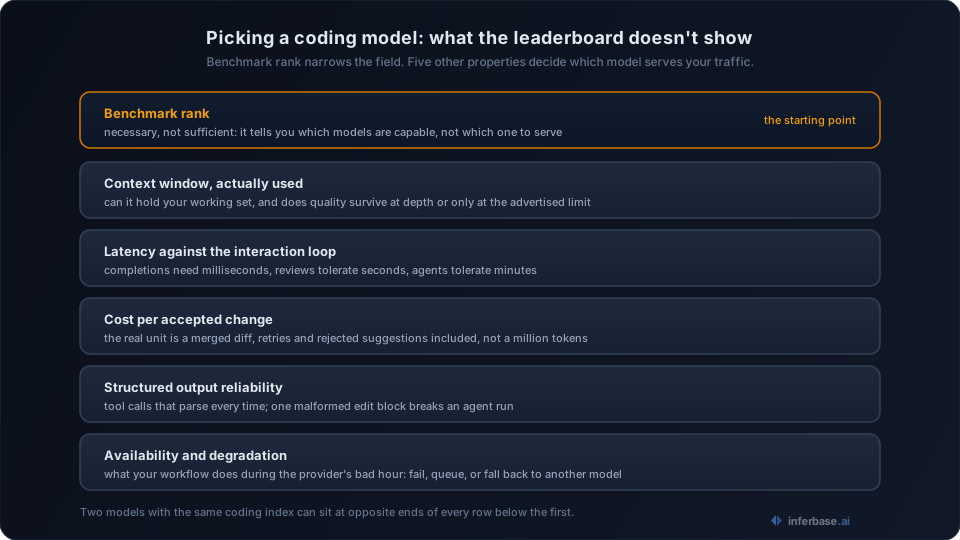
Framework-specific quality. A model with a high coding index may still produce outdated React patterns or incorrect SQLAlchemy syntax. Benchmark problems are typically framework-agnostic algorithmic challenges, not production code in specific ecosystems. The SWE-bench Verified benchmark attempts to address this by testing on real GitHub issues, but coverage remains limited.
Instruction adherence. The gap between "can write a function" and "writes the function you asked for, with the constraints you specified, without adding things you did not request" is real and poorly measured. This is often what separates a productive AI coding experience from a frustrating one.
Long-context code quality. Models advertise their context window limits but vary in how well they actually use that context. A model with a 1M token window that loses track of a variable definition at 50K tokens is worse than a 200K model that maintains coherence throughout its range. We explored this in our model comparison guide.
Integration quality. How well the model works in your specific IDE, with your specific extension, and in your specific workflow is something no benchmark measures. A model with slightly lower scores but better tool support, lower latency, and more reliable structured output may be the better practical choice.
Our recommendation
For coding quality without compromise, Claude Sonnet 4.6 is the best model available. Its coding index of 50.9 leads the field, and the 1M context window eliminates the need to fragment large codebase tasks. The cost is justified if coding quality directly impacts your team's output.
For cost-effective coding at scale, GPT-5.1-CODEX-mini offers the best balance of quality, speed, and price. At $0.25/$2.00 per million tokens with 159 tokens/sec throughput, it is the practical choice for teams that need strong coding performance without frontier pricing.
For budget-constrained high-volume work, DeepSeek V3.1-Terminus delivers the best quality-per-dollar. If your workflow involves batch code generation, test writing, or documentation, the cost savings are substantial with minimal quality trade-off.
Two places to go from here. The best models for coding page carries the current quality-ranked standings, rebuilt as benchmark evidence and pricing change, so it is the reference to check when this snapshot ages. And if the section on request shapes resonated, the applied follow-up is model routing for coding agents: how to send each part of a coding workload to the model tier it actually needs instead of averaging one choice across all of them.
All models in this guide are available in the Inferbase model catalog with full specs, benchmark data, and side-by-side comparison.