Every frontier code generation model in 2026 scores between 90% and 95% on HumanEval. The reported gap between any two of them rarely exceeds three percentage points, and the gap shifts by a similar amount depending on which evaluation harness was used. At first reading, the leaderboard suggests a meaningful capability difference among these models. At second reading, it suggests something else: HumanEval has stopped discriminating between the models that matter, and the numbers now function as marketing anchors rather than measurement.
The pattern is not limited to code. MMLU, the most widely cited general-knowledge benchmark, has clustered the top of the leaderboard between 87% and 92% for more than a year. Every quarter, a new frontier model posts a one or two point improvement on a benchmark that was never designed to measure the dimensions in which current models actually differ. The scores continue to appear in launch announcements because they are cheap to run and recognizable to buyers, but their capacity to guide technical decisions has largely eroded.
This post covers what the major benchmarks measure, why most are now unreliable as sole signals, and how to use them as part of a more disciplined model evaluation process.
What benchmarks actually measure
A benchmark consists of three parts: a dataset of inputs with known correct answers, a procedure for running those inputs through a model, and a scoring rule that converts model outputs into a numerical result. When a provider reports "Model X scores 92% on MMLU," they have executed the MMLU test set (14,079 multiple-choice questions across 57 subjects), used some standardized prompt format, and counted the fraction of questions the model answered correctly.
The score is a single number that collapses an enormous amount of structure. Two models with identical MMLU scores can fail on entirely different subsets of questions, strong on history and weak on mathematics versus strong on mathematics and weak on law. The aggregate percentage is also sensitive to the details of the evaluation run: prompt phrasing, few-shot example selection, temperature, whether chain-of-thought reasoning is permitted, whether the model is allowed to refuse questions. Two evaluations of the same model under slightly different conditions can produce scores that differ by three to five percentage points, which is larger than most reported model-to-model gaps.
This matters because benchmarks are usually consumed as if they were a stable property of a model. They are closer to a property of a model evaluated under a specific protocol, and most reported numbers do not fully specify that protocol.
A taxonomy of the major benchmarks
The most cited benchmarks fall into six capability clusters. Understanding which cluster a benchmark belongs to is more useful than memorizing any specific score, because it tells you which workloads the benchmark does and does not speak to.
Knowledge and general reasoning
| Benchmark | What it measures | Ceiling status |
|---|---|---|
| MMLU | 57-subject multiple-choice questions at high-school and college level | Saturated (top cluster 87-92%) |
| MMLU-Pro | Reworked MMLU with harder questions and 10 answer choices | Separating (top cluster 75-85%) |
| GPQA | Graduate-level physics, chemistry, biology (google-proof by design) | Separating (top cluster 55-75%) |
| ARC-Challenge | Grade-school science questions requiring reasoning | Saturated on easy set |
MMLU-Pro and GPQA were designed specifically to restore discrimination between top models after MMLU saturated. GPQA in particular is constructed so that non-expert humans with internet access cannot easily solve it, which forces the model to rely on internalized knowledge rather than retrieval patterns from training data.
Mathematics
| Benchmark | What it measures | Ceiling status |
|---|---|---|
| GSM8K | Grade-school word problems | Saturated (top cluster 95%+) |
| MATH | Competition math from AMC, AIME, and olympiad problems | Approaching ceiling (top cluster 85-95%) |
| AIME | American Invitational Mathematics Examination problems | Separating (top cluster 60-90%) |
Math benchmarks have been the clearest illustration of how quickly capability can advance. GSM8K was the frontier benchmark in 2022, and was saturated within two years. AIME is currently the primary math reasoning signal for frontier reasoning models, though it too is compressing as reasoning-optimized models improve.
Code generation
| Benchmark | What it measures | Ceiling status |
|---|---|---|
| HumanEval | 164 standalone Python function completions | Saturated (top cluster 90-95%) |
| MBPP | Basic Python programming problems | Saturated |
| SWE-Bench | Real GitHub issues from major open-source Python repos | Separating (top cluster 40-75%) |
| LiveCodeBench | Continuously refreshed competitive programming problems | Separating |
The gap between HumanEval and SWE-Bench is one of the most instructive in the benchmark landscape. A model can score 94% on HumanEval, which measures whether it can write a self-contained function from a docstring, and only 40% on SWE-Bench, which measures whether it can correctly edit a real codebase to resolve an actual bug report. These are both "coding" benchmarks. They measure fundamentally different skills. If the target workload is production engineering rather than competitive programming, SWE-Bench is the relevant signal. For a fuller treatment of how coding benchmarks translate to real development work, see our best LLM for coding analysis.
Instruction following and conversation
| Benchmark | What it measures | Ceiling status |
|---|---|---|
| IFEval | Strict-format instruction following (output length, punctuation, keywords) | Separating (top cluster 80-92%) |
| MT-Bench | Multi-turn conversation graded by GPT-4 as judge | Judge-limited |
| Chatbot Arena ELO | Head-to-head human preference comparisons | Robust, slow to saturate |
Chatbot Arena, maintained by LMSYS, is the most informative single number for overall model quality because it is grounded in human preferences across open-ended tasks. It is also the slowest to update and the least amenable to gaming, because the test set is effectively whatever users type in. The tradeoff is that ELO scores conflate many dimensions: a model with a high ELO is liked on average across a mixed user base, but that tells you less about any specific capability than a task-targeted benchmark would.
Tool use and agentic behavior
| Benchmark | What it measures | Ceiling status |
|---|---|---|
| Tau-bench | Multi-step tool use in retail and airline customer service | Separating (top cluster 40-70%) |
| BFCL (Berkeley Function Calling) | Function-calling accuracy across tool APIs | Separating (top cluster 80-92%) |
| WebArena | Browser-based task completion | Separating (top cluster 30-60%) |
Tool-use benchmarks are the most important category for teams building agentic applications, and they are also the most underreported in model launches. A model that scores highly on MMLU can fail on Tau-bench because the skills are only weakly correlated: knowing facts is not the same as correctly deciding when to call which tool and how to synthesize its result.
Safety, truthfulness, and alignment
| Benchmark | What it measures | Ceiling status |
|---|---|---|
| TruthfulQA | Resistance to popular misconceptions | Partially saturated |
| HHH (Helpful, Honest, Harmless) | Composite behavioral evaluation | Judge-limited |
| BBQ (Bias Benchmark for QA) | Demographic bias in model outputs | Separating |
Safety benchmarks have received less infrastructure investment than capability benchmarks, and their scoring methods are more contested. A high TruthfulQA score is not a guarantee that a model will behave well in deployment; it is evidence that the model avoids a specific curated set of misconceptions.
The three structural problems with reading benchmarks
Even when a benchmark is appropriate to the target workload and has not yet saturated, three structural problems complicate the interpretation of scores.
Saturation
A benchmark is saturated when the top models cluster within a narrow range near the maximum possible score. MMLU, HumanEval, GSM8K, and most legacy benchmarks have been saturated against frontier models for some time. On a saturated benchmark, reported differences of one or two percentage points fall within the noise of evaluation runs and should not be treated as meaningful. The signal-to-noise ratio has collapsed.
The standard response to saturation is to publish a harder benchmark. MMLU-Pro, GPQA, SWE-Bench Verified, and LiveCodeBench all exist because their predecessors lost the ability to discriminate. The cycle is expected to continue. Any benchmark that becomes the industry-standard headline number will eventually saturate as models are explicitly optimized for it, at which point a successor emerges.
Contamination
Benchmark contamination occurs when test-set questions or closely related text appear in the model's training data, which allows the model to retrieve rather than reason. Public benchmarks are particularly vulnerable because they are indexed, cached, and discussed on the web, all of which creates opportunities for ingestion into subsequent training corpora.
Detecting contamination is difficult. Independent research groups have demonstrated that several frontier models perform substantially better on benchmark questions that were published before their training cutoff than on questions of equal difficulty published after it. The gap is evidence that at least some of the reported score reflects memorization rather than capability.
The defenses against contamination are imperfect. Held-out test sets that are never published (the "Verified" variants of several benchmarks) are stronger in principle but rely on continuous curation. Dynamically refreshed benchmarks like LiveCodeBench rotate problems frequently to stay ahead of training cutoffs. For most public benchmarks, the safest assumption is that reported scores overstate true capability by an unknown but nonzero amount.
Distribution mismatch
Even a non-saturated, uncontaminated benchmark score may not predict performance on the target workload. Benchmarks measure performance on a specific input distribution, which is almost never identical to the distribution of inputs a deployed model will see.
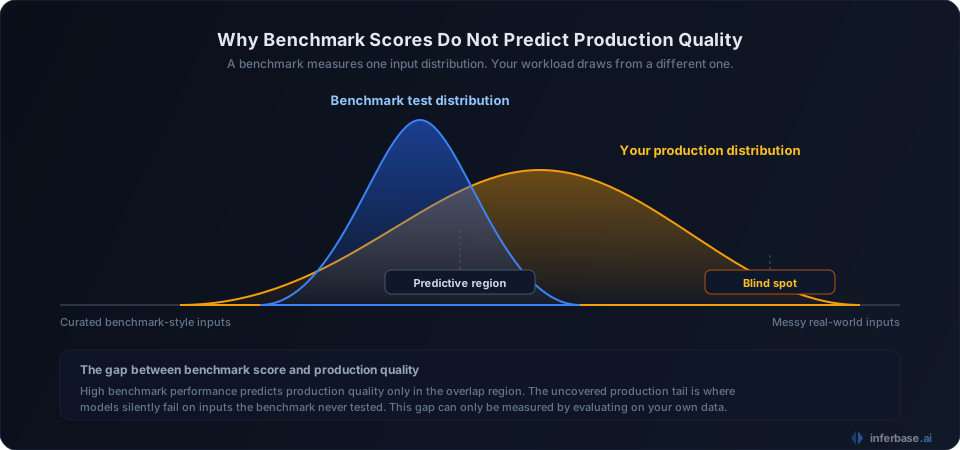
A model that scores 92% on MMLU has performed well on a sampled distribution of multiple-choice knowledge questions written to a specific style guide. A production workload might involve long conversational context, ambiguous user phrasing, mixed-language input, domain-specific jargon, or formatting requirements that the benchmark never tested. High benchmark performance is a prerequisite for high production performance on most tasks, but it is not a guarantee. The mapping between the two is workload-specific and must be measured directly.
This is the most important reason that benchmark-based model selection should always be followed by evaluation on an internal test set. The public score narrows the candidate pool. The internal evaluation picks the winner.
A practical framework for reading benchmarks
The goal of reading benchmarks critically is not to distrust them, but to extract as much signal as they can reliably provide. The following sequence is what we recommend to teams evaluating models at Inferbase.
Identify the two or three benchmarks whose task structure most closely resembles the target workload. For a coding agent, this might be SWE-Bench, LiveCodeBench, and BFCL. For a customer-support assistant, Tau-bench, IFEval, and Chatbot Arena. For an analytics copilot operating on internal documents, MMLU-Pro for knowledge, GPQA for harder reasoning, and an in-house retrieval-quality measurement. Ignore benchmarks that do not speak to the target workload regardless of how widely they are cited.
Weight recently introduced benchmarks higher than legacy ones. If the same capability is covered by both a saturated benchmark and a newer benchmark, prefer the newer one. MMLU-Pro is more informative than MMLU, SWE-Bench is more informative than HumanEval for production engineering, AIME is more informative than GSM8K for mathematical reasoning.
Treat provider-reported scores as directional. When a provider reports a score, the evaluation protocol is rarely fully specified. Cross-reference with independent evaluations where available: academic papers, the LMSYS leaderboards, and third-party platforms that run their own evaluations under controlled conditions. A two or three point discrepancy between a provider number and an independent number is within the range that evaluation protocol differences can explain.
Do not treat ties as ties. Two models reporting within two percentage points of each other on any single benchmark should be considered indistinguishable on that benchmark. Look at a different benchmark, or better, evaluate both on internal data.
Close with an internal evaluation. Benchmarks narrow the shortlist. Fifty to two hundred representative examples drawn from actual production data, scored by task-specific criteria, distinguish the shortlist. This is the step that no leaderboard can substitute for, and it is also the step most teams skip.
For a broader treatment of how to move from benchmark shortlisting to production model selection, see how to choose the right AI model.
Where Inferbase fits
Inferbase tracks benchmark scores for every model in its catalog with attribution to the source evaluation. Each model page exposes the scores in a structured form that can be compared across candidates, filtered by capability, and cross-referenced against independent evaluations where available. The benchmarks section is not the whole of the evaluation, but it is the starting point for building a defensible shortlist.
The catalog also surfaces the gap between headline benchmarks (where most models cluster) and the newer benchmarks that actually distinguish frontier models. Users evaluating models for production can filter on the benchmarks relevant to their workload rather than sorting on whichever benchmark a provider chose to feature in its launch announcement.
Benchmarks alone do not decide which model to ship. They narrow the pool of plausible candidates and establish upper bounds on capability. What distinguishes models in production is the interaction between that benchmark-measured capability and the specific structure of the workload, the quality of the inference infrastructure, and the operational characteristics of the provider. Benchmark literacy is the price of entry to that conversation, not the answer to it.
There is also a structural limit worth naming: a leaderboard answers the discovery question (which models are capable) and says nothing about the serving question (which of those models should handle this specific request, at this cost, under this latency budget). The discovery half is what this post covered. The serving half is model routing, and for the current quality-ranked standings by workload, our best models pages apply exactly the benchmark-reading discipline described above.