The "should we self-host Claude?" question shows up in nearly every architecture review for production agent workloads. The framing is wrong (there's no public-weights Claude), but the substance underneath is real. Teams running Claude Sonnet or Opus through the Anthropic API hit specific friction points (rate-limit tiers, regional capacity events, per-call cost ceilings on hot tool-use loops) and start asking whether an open-weight alternative on their own infrastructure would behave better.
The honest answer is: usually no, but for specific workload shapes, yes. This post walks through which shapes those are, what the realistic open-weight alternatives look like, and why the comparison is more about rate-limit mechanics than per-token pricing.
What "Claude-class" actually means in 2026
Claude Opus 4.7, Sonnet 4.6, and Haiku 4.5 are closed-weight proprietary models. The realistic open-weight substitutes for an agent workload that depends on Claude-tier reasoning quality:
| Claude tier | Closest open-weight match | Why |
|---|---|---|
| Opus 4.7 | DeepSeek V3 (671B/37B) | Strongest reasoning on math, code, multi-step chains. Heavier to host. |
| Opus 4.7 | Llama 4 Maverick (400B/17B) | Within 2-3 points on most reasoning benchmarks; lighter compute footprint via MoE active count. |
| Sonnet 4.6 | Llama 4 Maverick or Scout (109B/17B) | Scout fits common 4× H100 deployments at FP8; Maverick takes 8× but quality is closer to Sonnet. |
| Sonnet 4.6 | Mistral Large 3 | Best of the dense alternatives for tool-use formatting reliability. |
| Haiku 4.5 | Llama 3.3 70B or Mistral Large 3 | Easy to host, similar latency profile. |
None of these match Claude on every axis. The published benchmark gap is 2-5 points on reasoning, larger on instruction-following for complex agentic prompts, and noticeable on tool-use schema adherence. A Sonnet-trained agent that drops to Llama 4 Scout typically needs prompt re-tuning to recover most of that gap, plus a higher fallback rate on tool-call format errors.
The gap matters less when the agent's actual constraint is throughput, latency tail, or cost per token rather than peak reasoning quality.
Where the API math wins
The Anthropic API is hard to beat economically for most agent workloads, mostly because of two mechanics that don't appear in surface-level comparisons:
Prompt caching at 90% off. Cached input reads on Claude 4.x cost 0.1× the base input rate. For a typical production agent (say a 4K-token system prompt + 8K-token tool definitions + 2K-token retrieved context, with a 200-token user message and a 500-token response), the cache hit rate runs 85-95% once the deployment is warm. Effective input cost drops from $3 per million tokens to roughly $0.40 per million.
Cache reads don't count against ITPM rate limits. This one is underappreciated. On Claude 4.x models, cached input tokens are billed at 10% but are invisible to the rate limiter. A team at Tier 4 with a 2M ITPM ceiling and 80% cache hit rate has effective throughput of 10M input tokens per minute. The rate limit becomes 5× softer than the published number suggests.
Combined: for cache-friendly agent workloads, Claude Sonnet 4.6 delivers an effective $0.40-0.80 per million tokens with 5× more rate-limit headroom than the published tier suggests. To beat that with an open-weight self-host, you need a workload that either (a) doesn't benefit from caching, or (b) consumes enough sustained tokens that the cluster hours amortize against very high volume.
You can size the open-weight lane in the GPU Capacity Planner with the Llama 4 Maverick preset and a heavy production workload. It gives you the GPU count and throughput; turn that into a per-token cost with cluster hourly rates and compare it against Claude Sonnet rates from the pricing audit.
Where self-hosting wins
Three workload patterns where self-hosting an open-weight alternative beats the Anthropic API:
High-volume autonomous loops. Agents that run unattended at high frequency (overnight code refactoring, autonomous research, batch document analysis at 1M+ documents per night) push enough tokens through that the self-hosted cluster cost amortizes. The threshold is roughly 100B tokens per month per cluster for cache-unfriendly workloads, 200B+ for cache-friendly ones (because you're competing against Claude's effective post-cache rate).
Tier-1 and Tier-2 production teams. Anthropic's tier ladder is a real friction point. Tier 1 caps Sonnet 4.6 at 30,000 ITPM, which is one 30K-context request per minute. Reaching Tier 4 (4M ITPM) takes $400 cumulative deposit plus payment history, which routinely takes 3-6 weeks of usage. For a team that needs production rate limits on day one, a self-hosted Llama 4 Scout with 8× H100 cluster delivers ~3,500 ITPM on day one with no qualification ladder. Below ~$5K/month spend, the self-host beats the friction even if it's slightly more expensive per token.
Latency-critical interactive agents. TTFT on a kept-warm self-host of Llama 4 Maverick lands around 200-300ms; Claude Sonnet 4.6 from US-East typically lands at 400-600ms with a tail extending to 5-10s during regional capacity events. For real-time conversational agents or autonomous coding agents where the user experience depends on sub-300ms time-to-first-token, the self-host gives you measurably better tail latency.
Compliance / data residency. Regulated workloads (HIPAA, SOX, defense) where API egress isn't acceptable. The decision isn't economic at all; it's a compliance prerequisite.
A worked comparison
Production agent workload, a representative profile:
- 4K-token stable system prompt
- 8K-token tool definitions (also stable across requests)
- Average 1.5K-token retrieved context (varies per request)
- 500-token user message
- 2K-token response (with thinking + tool calls)
- 50,000 requests per day = 1.5M per month
- 80% cache hit rate on stable prefix
Claude Sonnet 4.6 via Anthropic API:
- Input tokens per request: 14K total, 11.5K cached at 0.1× → effective input billing = (2.5K × $3 + 11.5K × $0.30) / 1M = $0.0102 per request
- Output tokens: 2K × $15 / 1M = $0.0300 per request
- Per-request cost: ~$0.040
- Monthly: 1.5M × $0.040 = $60,000
Llama 4 Maverick self-hosted on 8× H100 SXM at FP8 (Runpod):
- Cluster cost: $23.92/hr × 24 × 30 = $17,222/month
- Sustained throughput: ~5,500 tok/s decode, ~12,000 tok/s prefill
- 1.5M requests × 16K input tokens = 24B input tokens/month
- Required input throughput: 24B / (30 × 24 × 3600) = 9,260 tok/s
- That fits within prefill capacity, leaving decode headroom for the 500-token responses
- Per-request cost: $17,222 / 1.5M = $0.0115 per request
- Monthly: $17,222 (vs $60K)
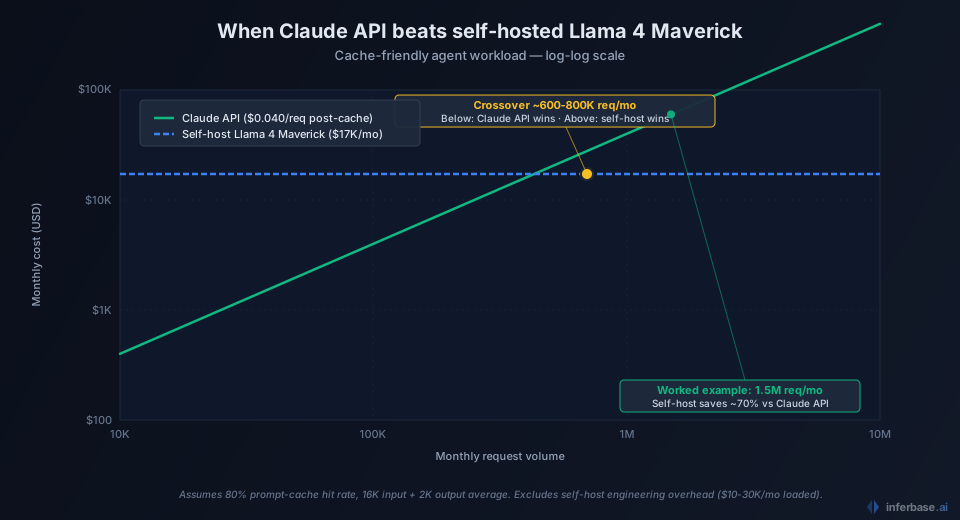
In this scenario the self-host saves roughly 70% of the monthly bill. But the scenario assumes:
- Constant load 24/7 (the cluster isn't sitting idle nights and weekends)
- Quality of Llama 4 Maverick is acceptable for the agent (a 2-5 point benchmark gap from Sonnet 4.6 may or may not matter for the use case)
- ~$15K-30K/month of loaded engineering time to keep the cluster healthy is acceptable
Drop request volume to 200K per month and the API cost falls to $8K/month while the cluster cost stays at $17K. The crossover is roughly 600K-800K requests per month for this workload shape.
What teams actually pick
In our experience working with production agent teams in 2025-2026:
- Below 100K requests/month: stay on Claude API. Self-hosting overhead outweighs any savings.
- 100K-1M requests/month: stay on Claude API but invest seriously in cache-friendly prompt design. The 90% cached-token discount + rate-limit relief makes Claude very hard to beat in this band.
- 1M-10M requests/month: real decision point. Audit your workload's cache hit rate, latency tail, and compliance requirements. If Claude friction (rate-limit tiers, occasional regional outages) is impacting your roadmap, self-hosting Llama 4 Maverick or DeepSeek V3 starts looking attractive.
- 10M+ requests/month: self-hosting almost always wins on cost, but the operational burden requires a dedicated platform team.
The GPU Capacity Planner lets you model the open-weight alternative for your specific workload before committing. The right comparison is full-loaded cost against Claude's effective post-cache rate, not the headline rate-card. Run both numbers before you decide.
When to revisit
This decision isn't one-and-done. Anthropic's API pricing has moved twice in the last 12 months, and the open-weight frontier (Llama 4 Maverick, DeepSeek V4, the next Mistral release) is moving faster. Sensible teams audit the comparison every quarter or whenever a new open-weight release lands in their quality target zone. The pricing audit covers the broader cost landscape these decisions sit inside; the hidden costs of LLM APIs covers the framework that should govern any comparison.
There is also a version of this decision that does not resolve to a single lane at all. The workload bands above rarely stay put: an agent fleet has peak-reasoning turns where Claude's quality edge earns its rate and high-volume routine turns where an open-weight model is indistinguishable, and the same team often ends up operating both. Once both lanes exist, the per-request choice between them is a model routing problem, and an LLM routing layer is the piece of infrastructure that runs self-hosted and API-served models behind one endpoint, re-making the selection against current prices and measured quality instead of re-litigating it each quarter.