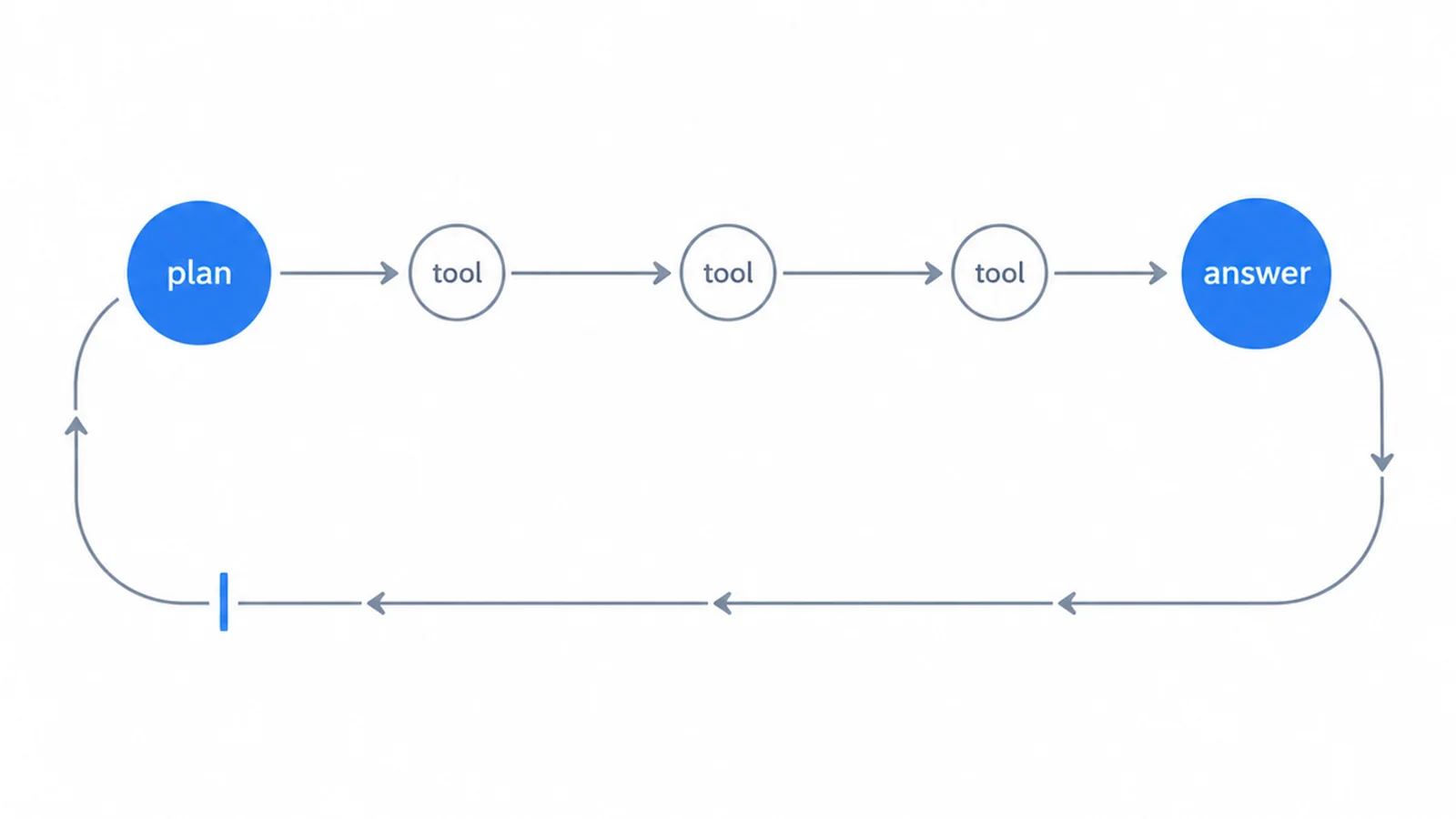
An agent loop where the planning call and the tool-calling steps are routed on what each one is, the loop stays on one model while a tool call is open, and the tools the agent may call are governed by policy. Built from scratch with a sandbox, four tools and one session per run.
What you build
A service that takes a task against a repository, runs an agent loop in a sandbox, and returns a diff with its reasoning. The loop makes two kinds of call: a plan and a final answer that ask for quality, and tool steps that ask for latency. Every call sends the model as auto under one routing policy whose pool holds only models with confirmed tool support, carries the same session identifier so the run is one record, and is bounded by the policy's caps on requests and spend per session. The tools the agent may call are an allow-list in that policy, taken from a dry run to enforced.
When you are done
- A service that turns a task and a repository into a diff, with each step's model, cost and tool calls on record
- Planning and synthesis on the strongest model in the pool, tool steps on the fastest, without naming either in code
- A tool surface that is a list in the policy: dry-run first, then enforced
- Runs that end on your rule or on the policy caps, never on a forgotten counter
- An evaluation that reports pass rate, cost and steps per task, for auto against a pinned model
The components
- Task intake
- An HTTP endpoint or a queue consumer that receives a task, a repository and a base commit, and starts a run with a fresh session identifier.
- Sandbox
- A container per run with the repository checked out at the base commit, where tools read files, run tests and apply patches. Nothing the model asks for runs outside it.
- Tools
- Four functions declared on every tool step: list_files, read_file, run_tests, apply_patch. Each is a thin wrapper over the sandbox with a size cap on what it returns.
- The loop
- Plan, then tool steps until the model answers without a tool call or the step limit is reached, then the final answer. Each call carries the routing object for its kind.
- Inferbase
- The key, the routing policy with its rule pool, task rule, allow-list and session caps, and the chat completions endpoint.
- Run record
- Each call's request id, model, cost and tool calls, stored with the run; the same facts appear under Usage as one agent run grouped by the session.
- Evaluation harness
- A set of tasks with hidden tests. Runs each through the service and scores whether the tests pass, how many steps it took, and what it cost.
The problem
A coding agent makes many calls per task, and they are not the same kind of call.
One task is a plan call, several tool-choice calls, a few summaries of tool output, and a final answer. The plan and the final answer need the strongest reasoning in the pool. Choosing the next tool and formatting its arguments does not, and a model that is good at it answers in a fraction of the time. A loop that sends every step to one frontier model pays the plan price twenty times and waits for it twenty times, because sequential calls add up.
The opposite mistake is as common: a cheap model everywhere, until the plan is wrong and the loop spends its budget executing it. And whichever model is chosen, a tool call that comes back mangled costs a retry at best and a wrong edit at worst.
The third problem is the tool surface. The list of functions an agent may call lives in the application code, changes with every deploy, and is seen by nobody who is responsible for what the agent may do to a repository.
This guide routes each call on what it is. The plan asks for quality; the tool steps ask for latency; every call sends the model as auto under a policy that only admits models whose tool support is confirmed. A tool loop stays on the model that opened it, so a tool result never lands on a model that did not ask for it. The tools the agent may call are an allow-list in the policy, and a run that does not stop is stopped by the policy step and spend caps.
Who has it
- A team running an agent loop on one frontier model and watching the bill and the wall clock grow with it
- An internal coding assistant whose tool surface should be a list someone approved
- Anyone who needs each run on record: which model took which step, and what it cost
Architecture
System overview
Every component, grouped by who runs it. The product sits at the generation call; everything in your lanes is yours and unchanged by this design.
One request, end to end
Orchestration and tool execution stay in your stack. Inferbase chooses the model per call, keeps a tool loop on one model, and governs which tools the model may call.
- 01DeveloperTask intakePOST /runs with the task text, repository and base commit.A fresh session id, for example run-7f3a, is minted here.
- 02Task intakeSandboxStarts a container and checks out the repository at the base commit.The container is the only place tools execute.
- 03Agent loopInferbaseThe plan call: model auto, routing optimize quality and task coding, the session id, no tools.The strongest model in the pool for coding wins; 300 tokens of plan.
- 04Agent loopInferbaseA tool step: model auto, routing optimize latency and task coding, the same session, the four tools declared.Only models with confirmed tool support qualify. The response carries tool_calls.
- 05Agent loopSandboxExecutes each tool call: list files, read a file, run the tests. Output is capped at 8,000 characters.A tool result over the cap is summarised by a cheap call before it enters the history.
- 06Agent loopInferbaseThe next tool step with the results appended as tool messages.A conversation mid tool loop stays on the model that made the call.
- 07InferbaseInferbaseChecks every tool name against the allow-list; in Enforce a name outside it is refused with a 403 before any model is chosen; counts the session against its caps.Dry run serves and reports instead.
- 08Agent loopSandboxApplies the patch the model proposed and runs the tests again.The patch step may be pinned to one model when determinism matters.
- 09Agent loopInferbaseThe final answer: model auto, optimize quality, no tools, the diff and the test output in the prompt.Thinking on is fine here; it is the one call where reasoning pays.
- 10Agent loopRun recordStores each call's request id, model, cost and tool calls, then the diff.The same run appears under Usage, grouped by the session id.
- 11Task intakeDeveloperReturns the diff with the plan, the final explanation and the run's cost.Or opens a pull request on the repository host.
Deployment
Where each part runs, and what talks to what over the network.
What stays in your stack
- The loop and its stopping rule
- Tool implementations and the sandbox they run in
- Repository access and credentials
- The prompts for plan and final answer
Technology stack
One choice per layer, the alternative that was considered, and the reason. Swap any row; the Inferbase call does not change.
| Layer | Choice | Alternatives | Why |
|---|---|---|---|
| Language | Python 3.12 | TypeScript with the same SDK | The sandbox tooling (containers, git, test runners) is simplest to drive from Python; the loop is forty lines either way. |
| API client | openai 3.x with base_url set to Inferbase | The Anthropic SDK against the Messages endpoint; the OpenAI Agents SDK against the Responses endpoint | One client, tool calling in the OpenAI shape, the routing object through extra_body. The other two shapes work unchanged if the loop already uses them. |
| Sandbox | A container per run with the repository checked out, network limited to the repository host | A VM per run; a git worktree on the build machine for trusted internal use | A model-chosen command must run somewhere it cannot do harm. A container is cheap to start and destroy and contains the blast radius. |
| Tools | Four functions: list_files, read_file, run_tests, apply_patch | A shell tool | Named tools are an allow-list the policy can enforce and a record that reads. A shell tool is one name for everything and cannot be governed. |
| Models | model auto with the routing object per call: quality for plan and synthesis, latency for tool steps | One pinned model; two pinned models | The spread between the plan and a tool step is the whole saving, and auto picks within a pool that only holds tool-capable models. |
| Governance | The policy's tool allow-list, session caps and a task rule | Checks in the loop | A check in the loop is a deploy away from being removed. A policy rule applies to every key under it and has a revision history. |
| Run store | Postgres: runs, calls, tool calls | SQLite for a single instance | The run is the unit of debugging and of billing back to a team. Store each call's request id; the decision record is one GET away. |
| Evaluation | A task set with hidden tests, scored by pass rate, steps and cost | A public benchmark subset | Your repositories and your tasks. The hidden test is the oracle; cost and steps come from the receipts. |
What carries it
The Inferbase features this design rests on. Each exists in the product today and is linked to its documentation.
- Per-request objective and task
- The routing object on each call narrows the policy for that call: optimize for quality on the plan, for latency on tool steps, with the task fixed to coding so the router does not have to guess. Documentation
- Tool-capable models only
- With tools on the request and the model set to auto, routing is limited to models whose tool support is confirmed and whose tool-use quality is measured. A model with unknown tool support is excluded. Documentation
- The loop stays on its model
- A conversation mid tool loop stays on the model that made the call, and falls back only within that model, so a tool result is read by the model that asked for it. Documentation
- Tool governance
- The policy allow-lists the tool names a key may send, from Any tool through Dry run to Enforce, and records every tool a project sends and when it was first seen. Documentation
- Session caps
- One session identifier per run groups its calls under one agent run in Usage and subjects it to the policy caps on requests and spend per session. A loop that does not terminate is terminated. Documentation
- Task rules
- A rule for coding tries a named model first for that task alone, leaving every other task on the objective; a rule's model still has to clear the evidence bar. Documentation
- Pinned-model fallback
- A step pinned to one model falls back the way the policy says: the same model on another provider, a model you choose, auto, or none. Documentation
- The Responses API and the Anthropic shape
- An agent built on the OpenAI Agents SDK or the Anthropic SDK sends the shape it already sends. Tool definitions, tool choice, parallel calls and tool results work in either. Documentation
Build it step by step
Eight steps from an empty service to a governed loop. The code is Python; the two-call loop is also given in TypeScript in the section after the policy, and that version was run against the API. Each step ends with the thing it turns on.
Before you start
- An Inferbase account, a project, and a key with a spend cap for this service.
- A container runtime the service can drive (Docker or Podman), and a credential that can clone the repositories the agent will work on, scoped to read and to push branches.
- Python 3.12, the openai package, and a test runner the repositories use.
Step 1: Create the routing policy, with the allow-list in dry run
Build the pool by rule: supports tool calling. Set the objective to Balanced as the default; the loop overrides it per call. Add a task rule for coding if one model is known to produce the cleanest diffs in your codebase. Under Request, set the allow-list to Dry run with the four tool names; under Fallback, refuse tool requests the pool cannot serve; under Session, cap requests and spend per session to the bound of one run. Attach the policy to the service's key.
Dry run first because the first week of runs will show tools you did not expect: a tool a developer added, a name the model invented. The reports under Usage are the list to write before switching to Enforce.
Refuse, not serve, for tool requests the pool cannot serve. An agent served without its tools answers with prose that looks like progress and is not.
Step 2: The sandbox and the four tools
Start a container per run, clone the repository at the base commit, and expose four functions to the loop. Each returns text and caps it: a file over the cap is returned with a marker, a test run returns the tail of its output. Nothing the model sends is executed as a shell command; the tools are the only verbs.
import subprocess

CAP = 8_000


class Sandbox:
    def __init__(self, container: str):
        self.container = container  # started by intake: the repo checked out at the base commit

    def _run(self, *argv: str) -> str:
        out = subprocess.run(["docker", "exec", self.container, *argv], capture_output=True, text=True, timeout=120)
        text = (out.stdout + out.stderr).strip()
        return text if len(text) <= CAP else text[-CAP:] + "\n[... truncated]"

    def list_files(self, pattern: str = "**/*") -> str:
        return self._run("sh", "-c", f"cd /repo && git ls-files | grep -E '{pattern}' | head -200")

    def read_file(self, path: str) -> str:
        return self._run("sh", "-c", f"cd /repo && cat -- '{path}'")

    def run_tests(self, selector: str = "") -> str:
        return self._run("sh", "-c", f"cd /repo && python -m pytest -q {selector} 2>&1 | tail -80")

    def apply_patch(self, diff: str) -> str:
        return self._run("sh", "-c", f"cd /repo && printf '%s' '{diff}' | git apply --3way - && git diff --stat")


TOOLS = [
    {"type": "function", "function": {"name": "list_files", "description": "List files matching a pattern.", "parameters": {"type": "object", "properties": {"pattern": {"type": "string"}}, "required": []}}},
    {"type": "function", "function": {"name": "read_file", "description": "Read a file from the repository.", "parameters": {"type": "object", "properties": {"path": {"type": "string"}}, "required": ["path"]}}},
    {"type": "function", "function": {"name": "run_tests", "description": "Run the test suite, or a selector.", "parameters": {"type": "object", "properties": {"selector": {"type": "string"}}, "required": []}}},
    {"type": "function", "function": {"name": "apply_patch", "description": "Apply a unified diff to the repository.", "parameters": {"type": "object", "properties": {"diff": {"type": "string"}}, "required": ["diff"]}}},
]
The cap is a routing decision in disguise: a tool result of 8,000 characters keeps the history inside every pool model's window. Step 5 summarises what is over it.
Step 3: The plan call
One call with no tools, asking for quality and stating the task as coding. The prompt asks for a short plan: which files to look at, what the likely cause is, how to verify. Store the request id and the model; the plan goes into the first user message of the loop.
from openai import OpenAI

client = OpenAI(api_key="inf_your_api_key", base_url="https://api.inferbase.ai/api/v1/inference")


def plan(task: str, run_id: str) -> tuple[str, dict]:
    completion = client.chat.completions.create(
        model="auto",
        max_tokens=400,
        messages=[
            {"role": "system", "content": "You plan the work of a coding agent. Name the files to read, the likely cause, and how to verify. Five lines at most."},
            {"role": "user", "content": task},
        ],
        extra_body={"routing": {"optimize": "quality", "task": "coding", "session": run_id}},
    )
    return completion.choices[0].message.content or "", {"request_id": completion.id, "model": completion.model_extra["routing"]["model"]}
Step 4: The tool loop
Each step declares the four tools, asks for latency, states the task, and carries the session. When the model returns tool calls, execute them in the sandbox and append the results as tool messages; when it returns an answer, the loop ends. Cap the steps in code as well as in the policy. A name outside the allow-list is refused by the gateway before any model is chosen; the loop treats that 403 as a bug to fix, not a retry.
import json
from openai import APIStatusError


def run_loop(sandbox: Sandbox, task: str, plan_text: str, run_id: str, record: list[dict], max_steps: int = 20) -> str:
    messages = [
        {"role": "system", "content": "You are a coding agent. Read before you change. Run the tests after a patch. When the tests pass, answer with the diff and two sentences on the cause."},
        {"role": "user", "content": f"{task}\n\nPlan:\n{plan_text}"},
    ]
    for _ in range(max_steps):
        try:
            step = client.chat.completions.create(
                model="auto",
                max_tokens=800,
                messages=messages,
                tools=TOOLS,
                extra_body={"routing": {"optimize": "latency", "task": "coding", "session": run_id}, "extended_thinking": False},
            )
        except APIStatusError as exc:
            if exc.status_code in (402, 429):  # the session cap, or the key's limit: the run is over
                return f"stopped by the gateway: {exc.message}"
            raise  # a 403 naming a tool outside the allow-list is a bug in the tool list, not a retry
        choice = step.choices[0]
        record.append({"request_id": step.id, "model": step.model_extra["routing"]["model"], "tool_calls": [c.function.name for c in choice.message.tool_calls or []]})
        messages.append(choice.message)
        if choice.finish_reason != "tool_calls":
            return choice.message.content or ""
        for call in choice.message.tool_calls:
            args = json.loads(call.function.arguments or "{}")
            result = getattr(sandbox, call.function.name)(**args)
            messages.append({"role": "tool", "tool_call_id": call.id, "content": shorten(result, run_id)})
    return "step limit reached"
Step 5: Summarise long tool output with a cheap call
A test run that prints three hundred lines does not need to enter the history whole. When a result is over the cap, ask for a summary with the task set to summarisation and the objective set to cost; the cheapest model that clears the bar for summarisation does it. The summary replaces the output in the history, and the full text is kept in the run record.
def shorten(text: str, run_id: str, limit: int = 4_000) -> str:
    if len(text) <= limit:
        return text
    summary = client.chat.completions.create(
        model="auto",
        max_tokens=300,
        messages=[
            {"role": "system", "content": "Summarise tool output for a coding agent: which tests failed, the error messages, the file and line numbers. Keep every identifier."},
            {"role": "user", "content": text[-12_000:]},
        ],
        extra_body={"routing": {"optimize": "cost", "task": "summarisation", "session": run_id}, "extended_thinking": False},
    )
    return "[summarised]\n" + (summary.choices[0].message.content or "")
Three objectives in one run: quality for the plan, latency for the steps, cost for the summaries. Each is one word on the request, and none of them names a model.
Step 6: The final answer
When the loop ends with passing tests, one more call asks for quality with no tools: the diff and the last test output go in, and an explanation for the pull request comes out. This is the one call where thinking is worth its tokens, so leave extended_thinking unset and give it room.
def explain(diff: str, tests: str, run_id: str) -> str:
    completion = client.chat.completions.create(
        model="auto",
        max_tokens=1_500,
        messages=[
            {"role": "system", "content": "Write the pull request description: the cause, the change, how it was verified. Plain sentences."},
            {"role": "user", "content": f"Diff:\n{diff}\n\nTests:\n{tests}"},
        ],
        extra_body={"routing": {"optimize": "quality", "task": "coding", "session": run_id}},
    )
    return completion.choices[0].message.content or ""
Step 7: Pin where determinism matters
Some steps want the same model every time: a patch step whose diffs you have tuned prompts for, or a step that must produce arguments in an exact form. Name the model on that call instead of auto, and set the policy's pinned-model fallback to the same model on another provider, so a provider outage does not change the model. Everything else stays on auto.
# The patch step, pinned: the same model every time, the same model on another provider if it fails.
step = client.chat.completions.create(
    model="your-pinned-model-id",  # a catalog id; the policy's pinned-model fallback decides what happens if it fails
    max_tokens=800,
    messages=messages,
    tools=[TOOLS[3]],  # apply_patch only
    extra_body={"routing": {"session": run_id}},
)
Step 8: Intake, record, and the stopping rules
The intake mints the session id, starts the sandbox, runs plan, loop, explain, and stores the record: one row per call with its request id, model, cost and tool names, and one row for the run with the diff. Three things end a run: the model answering without a tool call, the step limit in code, and the policy caps, which arrive as a 429 on requests or a 402 on spend. All three are recorded as the run's outcome.
Switch the allow-list to Enforce once a week of dry-run reports shows nothing new. From then on, a tool outside the list is refused before any model is chosen, and the refusal is in the record.
import uuid


def run_task(task: str, repo: str, base: str) -> dict:
    run_id = f"run-{uuid.uuid4().hex[:8]}"  # one session: one record, one set of caps
    sandbox = start_sandbox(repo, base)
    record: list[dict] = []
    try:
        plan_text, plan_meta = plan(task, run_id)
        record.append({**plan_meta, "kind": "plan"})
        outcome = run_loop(sandbox, task, plan_text, run_id, record)
        diff = sandbox._run("sh", "-c", "cd /repo && git diff")
        tests = sandbox.run_tests()
        explanation = explain(diff, tests, run_id) if diff else outcome
        return {"run_id": run_id, "diff": diff, "explanation": explanation, "calls": record}
    finally:
        stop_sandbox(sandbox)
The routing policy
A rule pool of tool-capable models, Balanced as the default with the plan asking for quality per request, an enforced tool allow-list once Dry run has shown the list is complete, and caps per session.
| Stage | Setting | Value | Why |
|---|---|---|---|
| Pool | How the pool grows | Models that meet a rule: supports tool calling | New tool-capable models join as they arrive; a model that cannot call tools never enters the pool. |
| Routing | Optimization mode | Balanced | The policy default for calls that say nothing. The plan call overrides it to quality, the tool steps to latency, the summaries to cost, per request. |
| Routing | Rules | coding: try your preferred model first | When one model is known to produce the cleanest diffs in your codebase, a task rule tries it first and leaves every other task on the objective. |
| Request | Tools the app may call | Dry run, then Enforce | Run with Any tool to see what the agent sends, write the list, run it in Dry run until the reports stop surprising you, then Enforce. A tool outside the list is refused before any model is chosen. |
| Fallback | Tool requests the pool cannot serve | Refuse | A tool-carrying request should fail loudly rather than be served without its tools. |
| Fallback | Pinned model fallback | Same model on another provider | A pinned patch step should survive a provider outage without changing the model. |
| Session | Maximum requests and spend per session | 40 requests, $1.00 | The ceiling on one run. A run that reaches it gets a 429 or a 402, and the orchestration treats that as the stopping rule it forgot to write. |
Create it under Policies in the portal and attach it to the key the application uses; the steps are in Create a routing policy.
The call
The two kinds of call in one loop. The plan asks for quality; the tool steps ask for latency and carry the tools; both carry the same session identifier so the run is one record. Tool execution is a stub here, your sandbox in production; the full build above adds the sandbox, the summaries and the record.
import json
from openai import OpenAI

client = OpenAI(api_key="inf_your_api_key", base_url="https://api.inferbase.ai/api/v1/inference")

RUN = "run-7f3a"  # one session id per run: one record, one set of caps
TOOLS = [{
    "type": "function",
    "function": {
        "name": "read_file",
        "description": "Read a file from the repository.",
        "parameters": {
            "type": "object",
            "properties": {"path": {"type": "string"}},
            "required": ["path"],
        },
    },
}]


def read_file(path: str) -> str:  # your sandbox; a stub here
    return "def parse_dates(rows):\n    first = rows[0]  # IndexError on []\n    ..."


task = "The test test_parse_dates fails on an empty input. Find the cause in src/dates.py and propose the fix."

# 1. The plan: the strongest model the pool holds for coding.
plan = client.chat.completions.create(
    model="auto",
    max_tokens=300,
    messages=[{"role": "user", "content": f"Plan the steps to resolve this, in three lines:\n{task}"}],
    extra_body={"routing": {"optimize": "quality", "task": "coding", "session": RUN}},
)
print("plan by", plan.model_extra["routing"]["model"])

# 2. The tool steps: fast, tool-capable, and the loop stays on the model that opened it.
messages = [
    {"role": "system", "content": "You are a coding agent. Use tools to read code before answering."},
    {"role": "user", "content": f"{task}\n\nPlan:\n{plan.choices[0].message.content}"},
]
for _ in range(6):
    step = client.chat.completions.create(
        model="auto",
        max_tokens=400,
        messages=messages,
        tools=TOOLS,
        extra_body={"routing": {"optimize": "latency", "task": "coding", "session": RUN}},
    )
    choice = step.choices[0]
    messages.append(choice.message)
    if choice.finish_reason != "tool_calls":
        print("answer by", step.model_extra["routing"]["model"])
        print(choice.message.content)
        break
    for call in choice.message.tool_calls:
        args = json.loads(call.function.arguments)
        messages.append({"role": "tool", "tool_call_id": call.id, "content": read_file(**args)})
Both snippets were run against api.inferbase.ai on 2026-10-13: the plan routed to Kimi K3 or DeepSeek V3.2, the tool steps called read_file and answered on the model that opened the loop, and the whole run took about a minute non-streamed.
Open in PlaygroundAPI reference
Security and privacy
An agent that edits code is an agent that runs code. The controls are about where it runs, what it may call, and what it may spend.
- Execution is confined
- Tools run in a container per run with the repository and nothing else: no secrets mounted, network limited to the repository host. A model that asks for a shell gets no tool by that name.
- The tool list is policy
- The allow-list in the routing policy, enforced, refuses any name outside it before a model is chosen. The list has a revision history and applies to every key under the policy; a developer cannot widen it from the loop.
- Secrets stay out of the prompt
- Tool results are text from the sandbox. Environment variables, tokens and keys are never readable by a tool, so they are never in a prompt and never in a request log.
- Repository access is scoped
- The clone credential reads the repository and pushes branches. It cannot merge, delete or reach other repositories; a human merges the pull request.
- Spend is bounded twice
- The policy caps requests and spend per session, so one run cannot loop forever; the key caps spend per day, so many runs cannot either.
- Every call is recorded
- Each call's request id reads back its decision; the tool calls per run are under Usage; a tool seen for the first time raises an event. What the agent did is never a mystery after the fact.
Evaluation
A task set with hidden tests is the oracle. Run every task through the service and score three things per task: whether the hidden tests pass, how many steps it took, and what it cost from the receipts. Then run the same set with the plan and the steps pinned to one model and compare.
- Pass rate
- The fraction of tasks whose hidden tests pass on the diff the agent produced. The only quality number that matters for a coding agent.
- Steps and wall time
- From the run record: calls per run and elapsed time. A loop that reads the right file first is a loop that ends sooner; the plan quality shows up here.
- Cost per task
- Sum of cost_micros over the run's calls. Compare it by call kind: the plan and the explanation should dominate; if tool steps do, the latency objective is not landing on cheap models and the pool needs a look.
- Auto against pinned
- The same set with every call pinned to your current model. The difference in pass rate is the quality cost or gain of routing; the difference in cost per task is the saving.
- Read the decisions
- Group the auto run's calls by model. The plan should land on one or two strong models, the steps on one or two fast ones; anything else is a pool or rule to adjust.
results = []
for case in tasks:  # {"task": ..., "repo": ..., "base": ..., "hidden_tests": "tests/test_hidden.py"}
    run = run_task(case["task"], case["repo"], case["base"])
    passed = hidden_tests_pass(case["repo"], case["base"], run["diff"], case["hidden_tests"])
    cost = sum(call.get("cost_usd", 0) for call in run["calls"])
    results.append({"run_id": run["run_id"], "passed": passed, "steps": len(run["calls"]), "cost": cost})

print(f"pass rate {sum(r['passed'] for r in results) / len(results):.0%}, "
      f"median steps {sorted(r['steps'] for r in results)[len(results) // 2]}, "
      f"mean cost {sum(r['cost'] for r in results) / len(results):.4f} USD")
Operations
A run is the unit of everything: debugging, cost, governance. Keep the run record and read the gateway's view of the same run beside it.
- Agent runs under Usage
- Each session id is one run: every call with its model, task, cost, and the tools it declared and called. The run record you keep should agree with it; when they differ, the gateway is right.
- Tools first seen
- When a project sends a tool name for the first time, an event records it. A new verb in an agent is visible the day it appears, which is when to decide whether it belongs on the list.
- Dry-run reports
- A tool served outside a dry-run list is recorded with the tool and the key. When the reports go quiet for a week, enforce.
- Which model takes which call
- Group calls by routing objective and model. If tool steps are landing on a slow deployment, the latency evidence for that route is the thing to look at; a task rule is the fast fix.
- Stopped runs
- Runs that ended on a 429 or 402 are runs the caps caught. Read them: a cap that fires often is either too low or catching a loop that needs a better stopping rule.
- Policy changes
- The pool, the rule and the allow-list have a revision history. Change them with the evaluation in hand and rerun it.
Scaling and limits
Runs are independent, so the service scales by running more of them. The limits are the key, the sandbox host and the history length.
- Real time, measured
- Not an interactive-latency product, and it should not be sold as one. The verified two-call loop took about a minute non-streamed on 2026-10-13; a real task is several minutes of tool steps. What matters is throughput and the per-step overhead: the decision is tens of milliseconds per call, and each tool step waits on the provider's first token, 1.5 to 3.5 s under the latency objective on 2026-10-14. Run tasks in the background and report when done.
- Concurrent runs
- A queue in front of the intake and a sandbox per run. Each run is a few dozen requests over a few minutes; a key at 600 requests a minute carries many runs at once.
- History length
- Tool output capped at 8,000 characters and summarised above 4,000 keeps a 20-step run inside a 128k window. For longer runs, summarise the history itself at a checkpoint with a cost-objective call and carry the summary forward.
- Prompt caching
- The system prompt and the early history repeat on every step. Turn prompt caching on in the policy; the decision says whether the chosen provider caches.
- Sandbox cost
- A container per run is the price of safety. Pool warm containers for the repositories that run most, and destroy a container at the end of its run without exception.
- Parallel tool calls
- A model may return several tool calls at once. Execute them concurrently in the sandbox when they are reads, serially when one is a patch.
- Rate limits
- Raise the key's limit before the queue does it for you; a 429 from the key ends a run, as the loop treats it.
Troubleshooting
What goes wrong when this is built, what it means, and what to do. Each one was met while building or running it.
| Symptom | Cause | Fix |
|---|---|---|
| A tool call arrives with malformed arguments | The model mangled the JSON. With auto this is rare, because only models with measured tool-use quality qualify; with a pinned model it is the model. | Validate arguments and return the validation error as the tool result; the model corrects itself next step. If one model does it often, drop it from the pool. |
| The loop never ends | The model keeps calling tools without converging, and the code's step limit is high. | The policy caps end it with a 429 or 402; lower the per-session request cap to the length of a reasonable run, and the code limit below it. |
| 403 naming a tool | The allow-list is enforced and the loop sent a tool outside it. | Either the tool belongs on the list (add it) or the loop should not send it (fix the loop). The record names the tool and the key. |
| Tool steps are slow | The latency objective picked a deployment with poor throughput, or a reasoning model spent tokens thinking. | Send extended_thinking false on tool steps; check which route won under Usage; add a task rule that tries a known fast model first. |
| The plan is landing on a cheap model | The plan call is not sending optimize quality, or the pool holds no strong model that clears the bar for coding. | Check the routing object on the plan call; raise the eligibility bar or add a model with coding evidence. |
| The request fails saying no model qualifies | With tools on the request, no pool model has confirmed tool support, or the history exceeds every window. | Add tool-capable models to the pool; cap and summarise tool output as steps 2 and 5 do. The decision record's filter trail names the step that emptied the pool. |
| A tool result is read by a different model | The session id was dropped between steps, or a new conversation was started mid loop. | Send the same session on every call of a run and keep the tool activity in the history; the gateway keeps a loop on its model when it can see the loop. |
Extending
The loop is small and the seams are clear. Each extension changes one component.
- Repository tools through MCP
- Declare your Git platform's MCP server under Connections and let the policy allow tools by server; or let Inferbase call it, so the credential leaves the service. The tools and MCP guide covers both.
- The OpenAI Agents SDK
- Point the SDK at the Responses endpoint with the base URL changed; it sends the shape the endpoint takes, and the session rides in a header.
- Human approval gates
- Pause before apply_patch and ask a developer. The loop is yours; a gate is an await on a decision, with the session kept so the run resumes on its model.
- A review agent
- The same loop with read-only tools and a prompt that reviews a diff instead of writing one. Same policy, a different allow-list.
- Many repositories
- The sandbox is per run; the service is per team. A pool per team, if their compliance differs, is a policy per key.
- Your own keys
- Build the pool from a provider key or cloud account. The loop does not change; the policy decides whose credential serves each call.
What was measured
What one step costs before its first token, and what a short run took, on the public API. A loop pays the first-token wait on every step, so it is the figure that matters here.
| Measurement | Value |
|---|---|
| The verified two-call loop, plan plus tool steps, non-streamed, 2026-10-13 | about 60 s |
| Streamed answer, first token, latency objective, a short prompt (3 runs) | 1.5 to 3.5 s |
| Time to decide (classify and rank), live traffic, 2026-10-13 | p50 18 to 31 ms |
Measured from our own infrastructure in India against api.inferbase.ai on 2026-10-14, three runs each, client-side wall time including the network hop (about 0.25 s each way), thinking off. Every response returns its own figures.
Further reading
- The Inferbase quickstarts repository; the coding-agent folder for this guide is planned
- Guide: model routing for coding agents
- Tools and MCP on the API
- Tool governance
- The routing object on a request
- Routing policies: rules, fallback, session
- Client compatibility: the Agents SDK and Anthropic shapes
- Build guide: agents with tools and MCP
Frequently asked questions
Because the loop is mostly tool steps, and a tool step does not need the plan model. Sequential calls add their latencies, so a loop of twenty steps on a slow model is twenty times slower than it needs to be, and the bill follows. Pin where determinism matters, for example a step whose tool arguments must be exact, and route the rest.
Through the routing object on each request. The plan sends optimize quality; the steps send optimize latency; the summaries send optimize cost. Each narrows the policy for that call only, and none can widen it: the pool and the eligibility bar still apply, and an organisation can enforce the objective so a request cannot change it.
A conversation mid tool loop stays on the model that made the call, and if that model fails the fallback is the same model on another provider, never a different one. A turn whose history shows tool activity counts as a tool request even without a tools array, so the rule holds for the whole loop.
No. With tools on the request and the model set to auto, routing keeps only models whose tool support is confirmed and whose tool-use quality is measured. A model with unknown support is excluded rather than risked, and the policy decides whether a tool-carrying request no pool model can serve is refused or served anyway.
With the allow-list in the routing policy. Start with Any tool and read the tools your agent sends under Usage. Write the list and run it in Dry run, where a tool outside the list is served and reported. When the reports stop surprising you, switch to Enforce, where a tool outside the list is refused with a 403 before any model is chosen.
The policy session caps. One session identifier per run groups its calls, and the policy caps the requests and the spend one session may use. A run that reaches the request cap gets a 429 and one that reaches the spend cap gets a 402; the orchestration reads either as the stop it should have written.
Truncation drops the lines that matter as often as the lines that do not. A summary with the task set to summarisation and the objective set to cost keeps every identifier and error message at a fraction of the tokens, on the cheapest model that clears the bar, and the full text stays in the run record.
Yes. The Responses API is the shape the OpenAI Agents SDK uses, and the Anthropic Messages endpoint takes the Anthropic SDK with streaming, images and the full tool loop. Each sends the shape it already sends with the base URL changed; the routing object rides along as an extra body field.
An MCP client flattens a server's tools into ordinary function tools before the call, so an agent using MCP servers routes like any other tool-using agent. Declaring the servers under Connections lets the policy allow tools by server and show a tool from no declared server as drift. The tools and MCP guide covers the brokered mode, where Inferbase calls the servers itself.
One agent run under Usage, grouped by the session identifier: each call with its model, its task, its cost, and the tools it declared and called. The response id of any call reads back its full decision record. Your own run record holds the same facts beside the diff.