Training and inference are both forward passes through a neural network, and the confusion between them starts there. The mechanics look similar on a whiteboard. The operational realities are almost entirely different: different hardware, different software stacks, different cost structures, different teams, and different optimization priorities. For any team building on top of AI models rather than training them, these differences determine where control sits, where cost compounds, and which architectural decisions matter most.
This post expands the short comparison in our guide to AI inference into the technical and economic distinctions that matter when designing, costing, and operating AI workloads.
The structural difference
Training is a loop. A batch of examples enters the model, the forward pass produces predictions, a loss function measures how wrong those predictions are, and gradients flow backward through every layer to update the weights. The updated weights then process the next batch, and the process repeats for millions of iterations until the model converges. Nothing about the loop is accidental. Each step depends on the gradient computation of the step before it, and the entire procedure exists specifically to change the weights.
Inference is a straight line. A request enters the model, the forward pass produces an output, and the output is returned. No loss, no gradient, no update. The weights do not change during inference, and they do not need to. The forward pass is the only computation that runs, and it runs once per request.
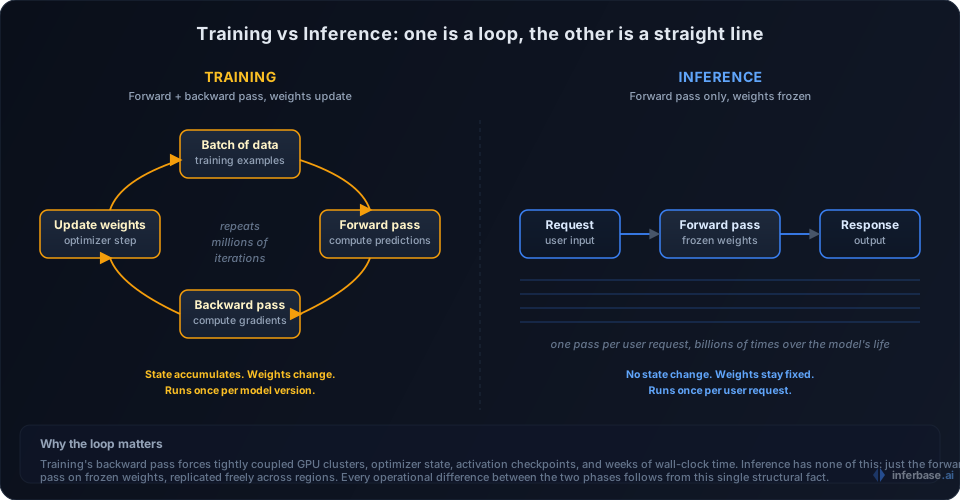
This structural distinction produces almost every downstream difference between the two phases. The need to store activations for the backward pass, the need for tightly coupled GPU clusters to exchange gradients, the cost of checkpointing training state, and the economic asymmetry between one-time and per-request compute all stem from the same core fact. Training maintains a loop of state. Inference does not.
Hardware differences
Training a frontier model requires tightly coupled clusters of GPUs, often hundreds or thousands of cards, connected by high-bandwidth interconnects such as NVLink within a node and InfiniBand or dedicated optical fabrics across nodes. The reason is gradient synchronization. When a model is split across GPUs using tensor, pipeline, or data parallelism, gradients computed on one device have to be aggregated with gradients computed on every other device before any weight update can happen. Network bandwidth between GPUs directly bounds training throughput, which is why training clusters are concentrated in specific facilities rather than distributed across regions.
Inference serving has the opposite topology. A single model is typically loaded onto one GPU for small and medium models, or onto a tensor-parallel group of two to eight GPUs for large models, and each serving instance handles requests independently. Instances can be replicated freely across regions. There is no gradient to synchronize across instances. For GPU-bound inference, the relevant resources are memory capacity (to fit the model weights plus the KV cache), memory bandwidth (which bounds decode throughput), and inter-GPU bandwidth within a single node. Wide-area network bandwidth, which is decisive for training, is largely irrelevant for inference.
A concrete contrast: GPT-4-class training runs have been documented to use over ten thousand H100 GPUs in a single cluster with dedicated InfiniBand fabric for several weeks. Serving the same model typically uses four to eight H100s per replica, with hundreds of replicas distributed across regions. The same class of chip performs both jobs, but the infrastructure around it is designed for entirely different workloads.
Software stack differences
The training stack is optimized for convergence. Frameworks like PyTorch combined with training-specific libraries such as DeepSpeed, Megatron-LM, and FSDP handle distributed weight updates, gradient accumulation, mixed-precision training, and recovery from node failures over multi-week runs. Checkpoint management, data pipelines, and experiment tracking are first-class concerns. The critical metric is wall-clock time to a converged checkpoint, measured in days or weeks.
The inference stack is optimized for throughput and latency per request. Serving engines like vLLM, TensorRT-LLM, and SGLang implement techniques that have no training analog: paged KV cache to reuse attention state across tokens, continuous batching to pack in-flight requests of different lengths onto the same GPU, speculative decoding to generate multiple tokens per forward pass, and prefix caching to share the cost of common prompt prefixes across users. The critical metrics are time-to-first-token, tokens-per-second per request, and requests-per-second per GPU at a target latency.
The two stacks share the same underlying GPU kernels (matrix multiplications, attention, layer normalization), but the orchestration layers above them have diverged to the point that training and inference code paths are effectively separate products. A team writing inference code would not reach for DeepSpeed, and a team running a training cluster would not deploy vLLM. Our guide to LLM inference covers the serving engine tier in more detail.
Memory and compute profile
Training memory is dominated by state that the forward pass does not need. For every parameter in the model, the optimizer stores at least two additional values (first and second moment estimates, in the case of Adam), the forward pass saves intermediate activations for use in the backward pass, and gradients are accumulated across mini-batches. The practical rule of thumb is that training a model takes between twelve and twenty bytes of GPU memory per parameter, compared to roughly two bytes per parameter in FP16 for inference. Training a seventy-billion-parameter model therefore requires on the order of a terabyte of GPU memory, which is why it has to be sharded across many cards.
Inference memory, by contrast, holds only the model weights and a per-request KV cache that grows with sequence length. The same seventy-billion-parameter model can run on a single node with four to eight 80GB GPUs in tensor parallel, with substantial headroom for concurrent requests. The model is a fixed cost per serving instance; the KV cache is the variable cost that grows with batch size and context length.
The compute profile differs similarly. Training is uniformly compute-bound: every step executes a full forward and backward pass on a full batch of input. Inference bifurcates between the prefill stage (compute-bound, similar in profile to a training forward pass) and the decode stage (memory-bandwidth bound, because each token generation reads the entire set of model weights plus KV cache for a single output token). This asymmetry is why inference-specific optimizations like speculative decoding and tensor parallelism across memory bandwidth exist, and why inference hardware selection often prioritizes memory bandwidth over raw FLOPS.
Cost structure: capital-like vs operating-like
Training cost is fixed per model version. A team that decides to train a frontier model pays the cluster, engineering, and data cost once, and the resulting weights then serve every user request from that point forward. From a finance perspective this is capital expenditure, amortized across the model's entire lifetime usage. A one-hundred-million-dollar training run that produces a model used for two years across a billion requests has an effective training cost of ten cents per request, at which point the training cost is negligible compared to the inference cost of each of those requests.
Inference cost is variable per request. Every user interaction consumes new GPU time. Doubling the number of users doubles the inference cost. Caching and batching reduce the per-request cost, but no optimization eliminates the fundamental scaling: more usage equals more inference.
The practical implication for product teams is sharp. Training economics are a vendor's problem, already absorbed into the per-token pricing of whatever API the team uses. Inference economics are the team's problem, and they scale directly with product adoption. A feature that costs a cent per use and has a million daily users has a three-hundred-thousand-dollar monthly inference bill. The same feature at half a cent per use has half that bill, and every architectural decision that touches inference (model selection, caching, routing, batch processing) compounds at production scale. Our breakdown of the hidden costs of LLM APIs expands on the specific factors that cause real inference bills to diverge from published list rates.
Who owns each phase
For almost all teams building with foundation models today, training is owned by the model provider (OpenAI, Anthropic, Meta, Google, DeepSeek, Mistral, and a small number of others). The team using the model inherits the weights at whatever point the provider published them. Except for fine-tuning, which is a smaller and shorter training run on top of an existing checkpoint, the team does not do training.
Inference is owned by the team. Whether they call a provider API, deploy a self-hosted model on rented GPUs, or use a unified inference platform, the responsibility for every inference request that serves their users sits with them. The cost, latency, and reliability of that inference layer is the team's problem, and it is where architectural choices actually matter at scale.
This division explains why inference has become the layer where AI product engineering actually happens. Training decisions are made by a handful of organizations. Inference decisions are made by every team that ships an AI feature.
Why the distinction matters for product teams
Four practical consequences follow from the training-versus-inference distinction, and each of them tends to surprise teams that have not previously operated AI workloads at scale.
Model quality is a training artifact; runtime behavior is an inference artifact. Changing a prompt changes inference. Changing a model's learned behavior requires training or fine-tuning. Teams that conflate these categories lose time debugging the wrong layer, for example trying to solve a prompt-engineering problem by requesting a new model version.
Training benchmarks predict inference cost poorly. A model with a strong score on MMLU or HumanEval might still be slow or expensive to serve. The benchmark measures output quality at a training checkpoint; the serving profile is a separate property of how that checkpoint runs on a given stack at a given concurrency level. Our post on LLM benchmarks covers how benchmark scores relate (and do not relate) to production performance.
Fine-tuning is a training-time intervention; retrieval is an inference-time intervention. When choosing between them, teams should match the problem to the phase. Behavioral changes that need to persist for every request belong in training. Request-specific context belongs in inference, usually via retrieval-augmented generation or structured prompt engineering.
Inference cost is where unit economics live. The cost per thousand users of an AI feature is an inference cost, computed per request and scaled by usage. Teams that model this early make better architectural choices than teams that treat inference as a downstream implementation concern and discover the bill at production scale.
Summary table
| Dimension | Training | Inference |
|---|---|---|
| Computation pattern | Loop (forward + backward + update) | Straight line (forward only) |
| Frequency | Once per model version | Once per user request |
| Duration | Days to months | Milliseconds to seconds |
| Hardware | 100s-1000s of GPUs, tightly coupled | 1-8 GPUs per replica, freely replicated |
| Memory per parameter | 12-20 bytes | ~2 bytes (FP16) |
| Compute profile | Compute-bound | Mixed (prefill compute-bound, decode memory-bound) |
| Software stack | PyTorch + DeepSpeed / Megatron / FSDP | vLLM / TensorRT-LLM / SGLang |
| Cost shape | Capital-like (fixed per model) | Operating-like (variable per request) |
| Who owns it | Model provider | Product team |
| Optimization priority | Convergence | Throughput, latency, cost |
| Primary bottleneck | Inter-GPU bandwidth | Memory bandwidth (for decode) |
What this means in practice
The short version, for teams that build on top of foundation models: training is a cost someone else has already paid, and its internal details rarely affect product decisions. Inference is a cost paid continuously, and its details determine the unit economics of every AI-powered feature. Treating inference as a first-class architectural concern, rather than as a call to someone else's API, is what separates teams whose AI products scale profitably from teams that encounter margin compression as usage grows.
For a systematic approach to choosing the right model for a given workload, see our guide to AI model selection; for the levers that reduce the inference bill once it exists, our cost optimization guide ranks them by effort and impact. The unified inference API provides the routing, fallback, and observability that production inference requires.