Almost everyone is busy arguing over ever-larger language models and chasing benchmark-topping giants, while a quieter shift has been unfolding in the background. A smaller, more practical category of models has been steadily gaining ground, not with hype, but with results.
Small language models (SLMs) are open-weight transformer models typically ranging from one to ten billion parameters. Over the past two years, they have emerged in high-volume for task-specific AI inference. As recently as 2022, they were barely considered viable for production, far behind larger, closed models on most meaningful tasks. But today, in 2026, that perception has changed in a very real way. SLMs now power a significant share of real-world workloads, especially where efficiency and cost matter more than absolute peak capability. They have become the layer where fine-tuning, on-device inference, and cost-conscious production systems actually operate. While frontier models continue to dominate the hardest problems and headline-grabbing demos, much of the day-to-day AI workload increasingly runs on this quieter, more efficient tier.
The shift has been driven by parallel changes in training methods, inference economics, and an open-weight ecosystem maturing to the point where small-model checkpoints from Microsoft, Google, Meta, Mistral, and Alibaba are genuinely competitive on most tasks. This post builds on the foundational guide to AI inference, the explanation of reasoning models, and the tool-calling primer to look at the model-size dimension that increasingly shapes how production AI workloads get deployed.
What an SLM actually is
By the working consensus, a small language model is a transformer-based language model somewhere in the one-to-ten billion parameter range. Below one billion, the models are usefully called tiny or on-device language models, and the deployment profile shifts toward phones, laptop CPUs, and embedded hardware where weight quantization and architectural tricks dominate the engineering. Above ten billion, the cost and latency footprint moves into a different regime, single-GPU consumer deployment becomes harder, fine-tuning gets expensive, and the trade-offs no longer cluster the same way.
The boundary itself is not absolute. It is a working consensus that reflects what hardware (a single A10, L4, or consumer-grade RTX), what economics (low single-digit cents per million tokens), and what workflows (overnight fine-tuning, single-host serving, durable on-device deployment) the size class actually enables. The frontier shifts every six months, and a 2026 four-billion-parameter model can match or exceed a 2023 thirteen-billion-parameter model on most public benchmarks. The number itself matters less than what it unlocks operationally.
It is also worth being clear about what an SLM is not. An SLM is not a quantized frontier model. A four-bit-quantized seventy-billion-parameter Llama is still a seventy-billion-parameter model in capability terms, with all the inference characteristics that implies, even though the on-disk size is smaller. An SLM is a model that was trained at small scale, with the architecture, data mixture, and training schedule all chosen for that scale, and that exhibits the capability and cost profile of its parameter count rather than of a model compressed into it.
Why the category exists now
Small models, of course, are not new. GPT-2 small, the early BERT variants, the distilled BERTs, and the original Llama 1 small variants all sat in the same parameter range. What changed over the last few years is the gap between a small model and a frontier model. In 2022, a seven-billion-parameter open-weight model was visibly worse than a frontier closed model on almost any task that mattered. By 2024, a well-trained seven-billion-parameter model was largely indistinguishable from a frontier model of two years prior, and after fine-tuning on a narrow task, it was indistinguishable from a contemporary frontier model on that task.
Three training developments closed the gap. The first was synthetic data and curated data mixtures, which let small models train on a much higher-quality token diet than was previously feasible. Microsoft's Phi series was the first widely visible demonstration that "textbooks are all you need" actually worked: a 2.7B model trained on a curated synthetic-textbook diet beat much larger models on reasoning benchmarks, and the technique has since generalized across families.
The second was instruction tuning and preference optimization, which transferred a large fraction of frontier-model capability to smaller models that had never seen the underlying training data. A small base model with a strong instruction-tuning pass approaches the usability of a much larger raw model on the tasks the instruction tuning targets. The third was distillation, in which small models are trained to mimic the outputs of larger models across a wide distribution of prompts. Distillation gives the small model a head start that pure pre-training would otherwise take a much larger token budget to match.
Combined, these techniques produced a generation of open-weight small models with a capability-per-parameter ratio that the 2022 understanding of scaling laws would have called impossible, and the SLM category as it exists today is the direct consequence of that progression.
The landscape
The active SLM landscape, as of mid-2026, is dominated by a small set of model families with releases and refreshes from each provider on a roughly six-month cadence.
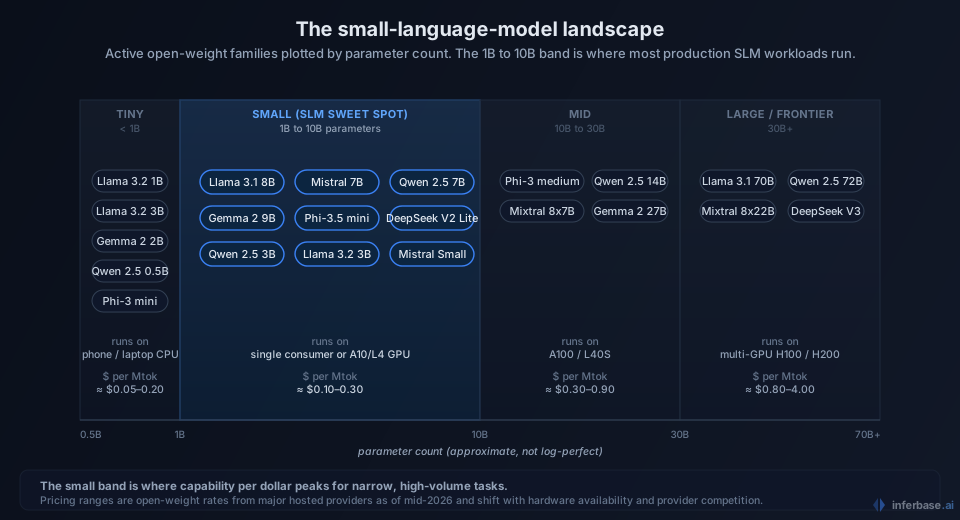
Microsoft's Phi family anchors the small end with strong reasoning per parameter; the Phi-3 mini and Phi-3.5 mini variants are widely deployed for cost-bounded reasoning workloads. Google's Gemma 2 (with 2B, 9B, and 27B variants) is widely deployed where strong instruction-following and tool calling matter at small scale. Meta's Llama 3.1 8B and Llama 3.2 (1B and 3B) cover the broadest open-weight SLM deployment surface and are the default choice on most hosting platforms.
Mistral 7B and the more recent Mistral Small line remain the European-grown anchors of the segment, with strong tool-calling reliability. Alibaba's Qwen 2.5 (in 0.5B, 3B, 7B, and 14B variants) and the smaller DeepSeek variants round out the landscape and have been increasingly competitive on coding and reasoning per parameter.
The landscape reflects a structural fact about training economics: the major frontier-model trainers all release small variants of their flagship architectures. Reusing the architecture, data pipeline, and infrastructure across scales is cheap, which means the small model often inherits the strengths and the weaknesses of the larger sibling at lower compute. This explains why Phi is strong on reasoning, Gemma is strong on instruction following, Llama is broad and well-instruction-tuned, and Qwen is strong on coding: each family reflects the priorities of its parent program.
What SLMs can do at near-frontier level
The capability gap between SLMs and frontier models is uneven, and on a wide set of common production tasks it is small enough that the cost differential ends up dominating the choice. The tasks where SLMs reliably hold up include classification (sentiment, intent, topic, content moderation, language detection), structured extraction (named-entity, key-value, JSON-mode output against a schema), summarization of short to medium documents, single-turn question answering on familiar topic distributions, and the routine generation tasks that fill chat applications (rewrite, translate, expand, condense, format-shift).
Tool calling also works reasonably well at SLM scale, though schema validity and tool-selection accuracy lag the frontier and tend to require tighter tool descriptions and more aggressive validation. Single-turn agent loops with two or three tools and a clear task structure run reliably on a well-instruction-tuned eight-billion-parameter model. The reliability degrades faster than at the frontier as the tool count grows or the task structure loosens.
Code generation is another area where SLMs hold up surprisingly well. On well-known languages (Python, JavaScript, SQL, Java) and standard tasks (CRUD, glue code, scripting, refactors, simple algorithms), SLMs deliver acceptable production quality, particularly the fine-tuned coding variants. The gap to a frontier coding model becomes visible on novel architectures, multi-file changes, and the kind of edge cases that the SLM has not seen during training.
The pattern across all of these is the same: when the prompt distribution sits inside what the SLM was trained and instruction-tuned on, the model performs at a level where the cost differential wins. The harder question, and the one that ultimately determines whether the SLM holds up in production, is how robust the model remains when the prompt drifts outside that distribution.
What SLMs do not do well
The capability ceiling, however, is real, and the gap to frontier models is widest on a specific set of tasks. The clearest weakness is in novel multi-step reasoning, where the answer requires combining facts the model has not seen combined before during training. Long-horizon planning is similarly hard: tasks that require holding a multi-step plan in working memory while executing intermediate actions tend to drift or lose coherence. Complex tool selection from a large registry, where the discriminating signal between similar tools is subtle, also exposes the gap, and so does cross-domain transfer where the prompt mixes content from domains that did not co-occur in training.
Long-context performance is another particular weak spot. Even when an SLM advertises a 128K or larger context window, retrieval accuracy across the window tends to degrade faster than for frontier models at the same length, and reasoning over the full context is materially weaker. The practical implication is that the advertised window length and the effective window length end up being two different numbers, with the gap between them widening at smaller scales. For long-document tasks where the context actually matters, frontier models or retrieval-augmented architectures with smaller windows often outperform large-context SLMs at lower total cost.
The capability gap is most visible on tasks where there is no established training distribution to lean on: high-quality open-ended creative writing, expert-domain question answering in fields with limited public training data, and multi-step reasoning on problems that combine three or four uncommon facts. The gap is least visible on the high-volume routine tasks that fill most production AI deployments, which is exactly why the SLM tier has captured so much of that volume in the first place.
The fine-tuning advantage
The single largest reason SLMs persist as a category, rather than being eaten from above by improved frontier models, comes down to fine-tuning economics. A frontier model is too large to fine-tune affordably outside of dedicated provider platforms, and those platforms charge accordingly. An SLM in the one-to-ten billion range, by contrast, can be fine-tuned with LoRA or QLoRA on a single eight-GPU host overnight, using task-specific data that the team owns and controls. The resulting fine-tuned SLM often matches or exceeds a generalist frontier model on the trained task, at roughly one-tenth to one-fiftieth the inference cost.
This dynamic is what makes the SLM tier strategically interesting rather than just economically convenient. The frontier-model trainers cannot easily make their flagship models cheap to fine-tune, since the architecture is simply too large. What they can do is release smaller variants of those flagships and let the production tier specialize them downstream. The SLM has effectively become the layer where domain-specific value gets added on top of the open-weight ecosystem, and that value compounds over time: each successful fine-tune is a body of in-house technique that does not transfer cleanly to a new vendor's hosted API.
The corollary is that the SLM-versus-frontier choice in production is rarely about whether an off-the-shelf SLM matches a frontier model. The more useful question is whether a fine-tuned SLM matches the frontier model on this team's data and for this team's task, and the answer is yes more often than the off-the-shelf comparison would suggest.
Deployment economics
The most immediate argument for SLMs is the cost differential. A typical hosted SLM in the seven-to-nine billion range delivers inference at roughly $0.10 to $0.30 per million tokens, while a frontier closed model lands in the $1 to $20 per million tokens range depending on the tier. The differential is one to two orders of magnitude on the bulk-token rate, larger after batching and prompt-caching effects, and larger still when the model is self-hosted on owned hardware.
Latency is the second axis along which the economics shift. SLMs run at higher throughput per GPU and can saturate continuous-batching schedulers more easily, which translates into lower per-request latency under load. A well-tuned SLM deployment serving an eight-billion-parameter model on a single L4 or A10 GPU can deliver first-token latency in the low hundreds of milliseconds, while a frontier model behind a hosted API tends to land at several hundred milliseconds even under low load. This matters for any latency-sensitive workload (voice agents, IDE autocomplete, in-loop classification) where the per-request cost includes the user-perceived wait.
Deployment flexibility is the third. SLMs can run on consumer GPUs, on single-host servers, on edge devices, and on user hardware, none of which can practically host a frontier model in any meaningful configuration. This unlocks deployment patterns (on-device inference, fully offline products, tightly latency-budgeted in-loop systems) that are simply not available at the frontier. Our GPU sizing guide for LLM inference covers the hardware-side trade-offs in more depth.
When to use an SLM
In practice, the right question to ask is not whether an SLM is good enough in the abstract, but whether the cost-adjusted SLM is good enough for this particular workload. The patterns that tend to favor an SLM:
- High-volume narrow tasks. Classification, extraction, routing, simple QA, and summarization at production volume amortize the fine-tuning investment and convert the cost differential into ongoing operating savings.
- Latency-sensitive in-loop work. Voice agents, IDE assistants, real-time classification, and product features where the user is waiting on the model all benefit from the lower latency and higher throughput of small models.
- On-device or offline deployment. Mobile apps, desktop software, and edge devices where data cannot leave the device, or where network connectivity is unreliable, need SLMs by construction.
- Specialization with owned data. Tasks where the team has a labeled or domain-specific dataset and wants the resulting model to reflect that specialization durably are well served by SLM fine-tuning.
- Cost-bounded production loops. Agentic loops with many turns, batch inference at scale, and any deployment pattern where the per-call cost compounds materially make the SLM cost differential decisive.
The patterns that tend to disfavor an SLM, on the other hand:
- Genuinely novel reasoning. Hard math, complex code, and multi-step planning over unfamiliar domains all favor the broader training-distribution coverage of a frontier model.
- Long-context tasks where the context matters. SLM long-context retrieval is unreliable, and if the answer depends on faithful recall across a 50K+ token window, frontier models or retrieval architectures will outperform.
- Cross-domain transfer at quality. Open-ended writing, expert question answering across many fields, and sophisticated creative work all rely on training-distribution coverage that is hard to match below the frontier parameter count.
- Workloads where the prompt distribution is unknown. When the task surface cannot be characterized in advance, the SLM's robustness margin becomes a meaningful risk.
Summary table
| Dimension | Small Language Model (1-10B) | Frontier LLM (100B+) |
|---|---|---|
| Inference cost per million tokens | $0.10 to $0.30 | $1 to $20+ |
| Hardware footprint | Single L4 / A10 / consumer GPU | Multi-GPU H100 / H200 cluster |
| First-token latency under load | 100-300 ms | 300 ms to several seconds |
| Fine-tuning feasibility | Affordable (LoRA on single host) | Provider-platform only |
| On-device deployment | Yes (especially sub-3B variants) | No |
| Capability on routine tasks | Approaches frontier with fine-tuning | Frontier |
| Capability on novel reasoning | Materially weaker | Frontier |
| Long-context reliability | Weak above ~32K effective | Stronger but still imperfect |
| Tool calling | Native, lower schema validity | Native, high schema validity |
| Strategic position | Specialization layer | Generalist layer |
What this means in practice
The production AI stack has become increasingly bifurcated, with the frontier tier serving the hard problems and the visible demos, while the SLM tier serves the volume of routine production traffic. Most production AI workloads in 2026 are either pure SLM, or a routing layer that sends easy traffic to an SLM and hard traffic to the frontier, with the SLM share of volume rising over time as the smaller models continue to improve and as fine-tuning maturity grows inside production teams.
The implication for engineering teams is that capability is no longer the only meaningful axis of model selection. A frontier model is the right default for prototyping, where capability dominates and cost does not. A fine-tuned SLM, or a carefully routed mix of SLMs and frontier models, is increasingly the right default for production, where the discriminating axis becomes cost-adjusted capability per workload. Teams that do not actively measure their per-workload model fit tend to end up paying frontier rates for SLM-class tasks, which has quietly become one of the largest avoidable cost categories in production AI.
For multi-model deployments, the routing layer is where most of the engineering value actually lives. A well-designed router classifies incoming traffic by capability requirement, dispatches to the smallest model that will do, falls back to a larger model when the small one declines or fails validation, and instruments the per-class success rates so the routing thresholds can be tuned over time. Right-sizing the model per request is the core idea of model routing, and building it in-house is entirely feasible, though buying it from a platform that runs LLM routing as a service tends to be faster in practice.
For teams looking to prototype workloads against multiple SLM and frontier families on a single API, the Inferbase unified inference API exposes the major open-weight SLMs alongside frontier closed models with consistent tool-calling and structured-output behavior. The GPU capacity planning tool covers the related hardware question of what it takes to self-host a given SLM at a target throughput.